The hidden cost of a menu guests don't fully understand
Restaurant owners often think about multilingual menus as a hospitality feature.
"We have international guests, so we should have their language available."
That's true, but it misses the bigger commercial opportunity.
Your menu is one of your most important sales tools. Every dish description, category, recommendation, photo, and price is part of the decision-making process.
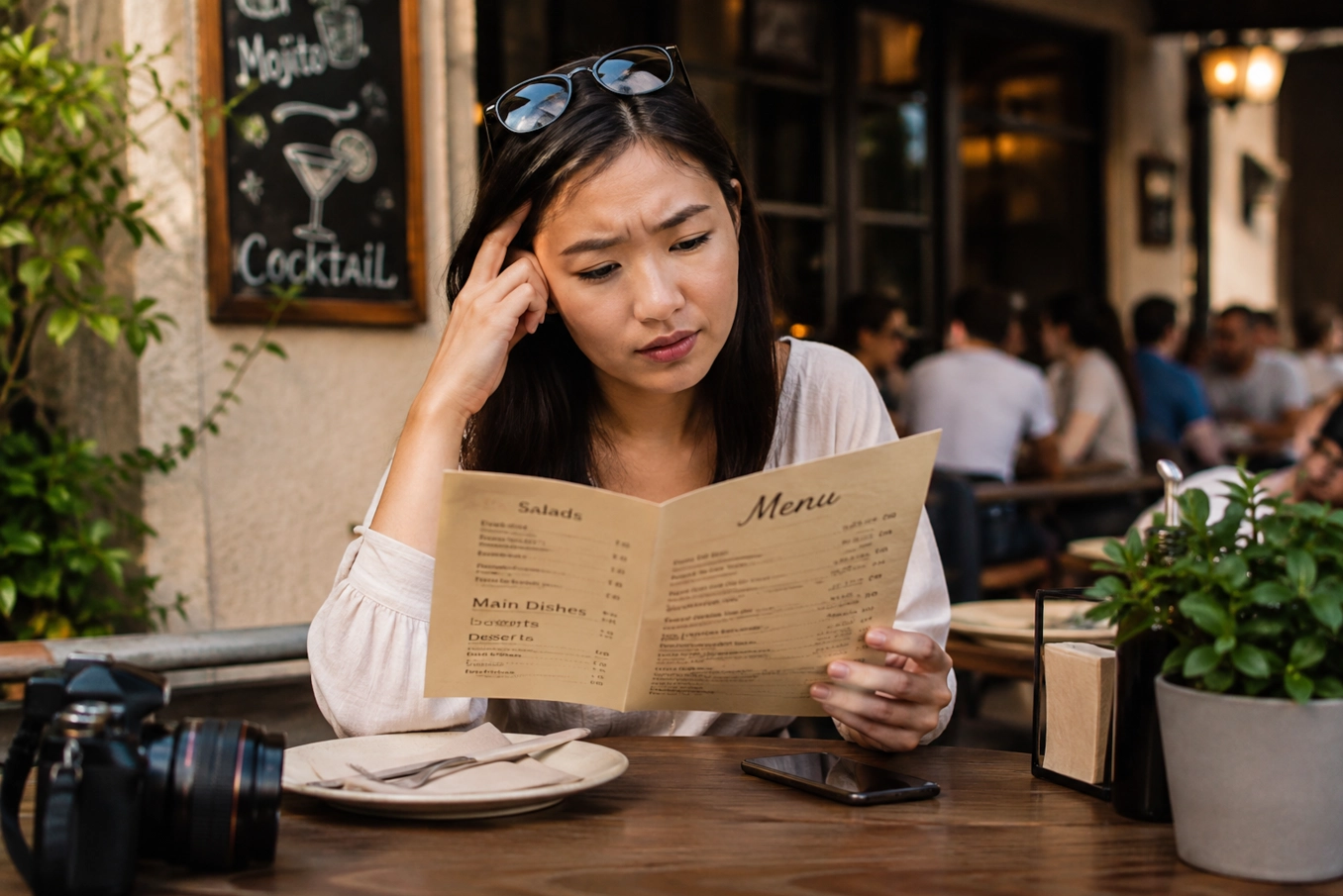
If a guest struggles to understand the menu, the problem isn't simply that their experience is slightly less convenient.
Their purchasing behavior can change.
A guest who feels uncertain is less likely to:
Try an unfamiliar dish
Add a starter
Order a side
Upgrade to a premium option
Explore local specialties
Order another drink
Ask questions about ingredients
Take a recommendation they don't fully understand
In other words, language friction can reduce the size of the basket.
And unlike a slow waiter or a long kitchen delay, this problem can happen silently.
Nobody complains. The guest simply orders less.
Why guests become conservative when reading a second language
Understanding a language and feeling completely comfortable making purchasing decisions in that language are two different things.
A guest may understand English reasonably well, for example, but still struggle with:
Local ingredients
Cooking methods
Food terminology
Allergens
Regional dishes
Descriptive language
Portion information
Restaurant menus make this even harder because they often use specialized vocabulary.
Imagine seeing a dish described as a local specialty with several unfamiliar ingredients. You could ask the waiter what everything means.
But many guests won't. They don't want to hold up the table. They don't want to look confused. They may simply choose something familiar.
This is especially important for groups.
If one person understands the menu better than the others, that person may effectively become the translator for the table. The group then gravitates toward dishes everyone recognizes.
The result is predictable: less exploration and often a smaller order.
Confidence is part of the buying decision
Restaurants spend enormous amounts of time improving food presentation.
They invest in better photography, plating, lighting, interior design, service training, and menu layouts.
But there is another part of presentation that is easy to underestimate: language clarity.
A guest needs enough information to feel comfortable saying: "Yes, I'll have that."
The easier that decision feels, the more likely the guest is to explore the menu.
A strong multilingual menu doesn't merely translate words.
It helps recreate the same decision-making experience for guests who speak different languages.
That means translating the information that actually matters:
What the dish is
What's in it
How it is prepared
What makes it special
What portion to expect
Relevant dietary or allergen information
When guests can understand the value of a dish without needing additional explanation, the barrier between interest and purchase becomes smaller.
The difference between translation and useful translation
Not every multilingual menu solves the problem.
A restaurant can technically offer several languages and still create confusion.
Poor translations can be awkward, incomplete, overly literal, or difficult to understand.
That creates a different kind of friction.
The goal isn't to prove that your menu has been translated.
The goal is to make the guest feel: "I understand what I'm ordering."
This is where digital menus have an advantage over traditional printed menus.
A paper menu might need separate pages, separate versions, or even completely different printed menus for different languages.
A digital menu can make multiple languages available without making the physical menu larger or more complicated.
The guest simply selects a language and continues browsing.
Oto makes the multilingual experience measurable
This is where Oto goes beyond simply putting a digital menu online.
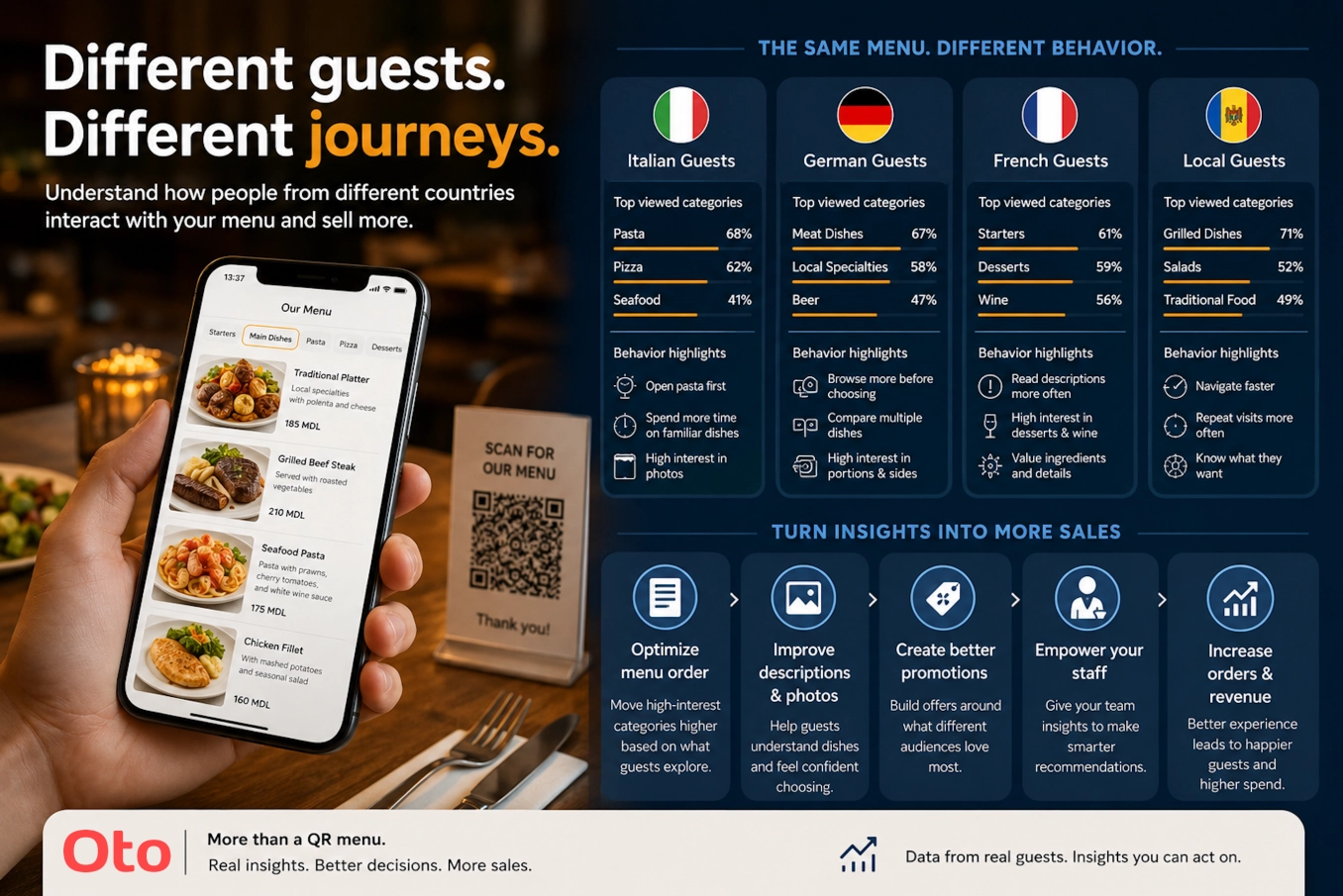
Oto clients can see guest-origin information in the admin panel based on the country associated with the phone or device that scans the restaurant's QR code.
In practical terms, this gives restaurant owners another useful piece of information: where their menu traffic is coming from.
For example, a restaurant might discover that its menu is being scanned by visitors from several different countries, even if staff rarely notice those differences during service.
That information can help answer questions such as:
Which international audiences are actually visiting?
Are we getting more international traffic than we expected?
Which countries are represented among menu visitors?
Do international visitors interact with the menu differently?
Should we prioritize certain languages?
Are we attracting international guests but failing to convert their interest into larger orders?
It turns the multilingual menu from a static feature into part of a data-driven digital guest experience.
One important distinction: this should be understood as country information associated with the device or connection, not as personally identifying or guaranteed nationality information about an individual guest.
The Oto approach: Make the menu easier to understand
With Oto, restaurants can make their digital menu available in multiple languages without creating a collection of different printed menus.
Guests can browse the menu in the language they are most comfortable with while the restaurant maintains one central digital menu.
That matters operationally too.
Imagine a restaurant with several printed menus in different languages.
Every time a price changes, a dish is removed, an ingredient changes, or a new dish is introduced, someone needs to update every version.
That's not just inconvenient. It's a maintenance problem.
With a digital menu, changes can be managed centrally, reducing the risk that a guest receives outdated information.
Multilingual menus also reduce pressure on staff
There is another benefit that doesn't show up directly on the bill.
A multilingual menu can reduce repetitive questions for restaurant staff.
During a busy service, a waiter might repeatedly hear:
"What is this dish?"
"What's inside it?"
"Is this spicy?"
"How big is the portion?"
"What does this ingredient mean?"
"Which one would you recommend?"
Some questions are an important part of hospitality. Guests should always be able to ask for help.
But staff shouldn't have to spend valuable time translating the entire menu for every table.
A clear digital menu can handle much of the basic information before the waiter arrives.
That allows staff to spend more time on the interactions that actually require a human.
Technology shouldn't replace hospitality. It should remove the repetitive work that gets in the way of hospitality.
A better experience for international guests
There is also a psychological effect.
When a restaurant offers a guest the ability to browse in their preferred language, it signals something simple:
"We thought about you."
That can make an international guest feel more comfortable from the first interaction.
Instead of depending on a companion to translate. Instead of searching for unfamiliar food terms online. Instead of waiting for a waiter to explain every dish.
They can explore independently.
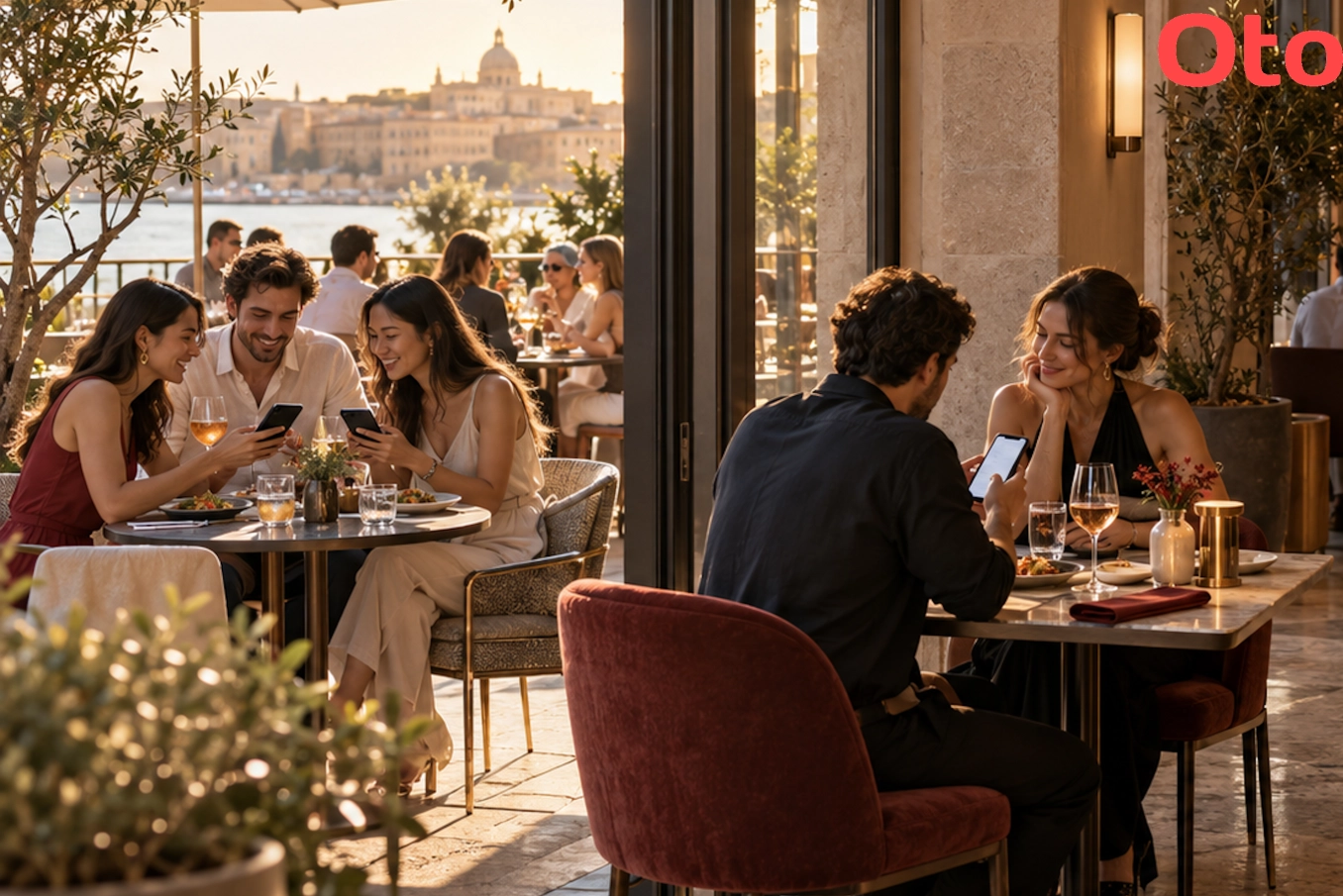
This is particularly useful in restaurants located in tourist destinations, hotels, airports, city centers, resorts, and other places where international traffic is common.
The digital menu becomes part of the overall guest experience rather than simply a replacement for paper.
The bigger opportunity: Turn the menu into a sales tool
The most important shift for restaurant owners is to stop thinking about the menu as an information sheet.
Your menu is a salesperson.
It introduces products.
It explains value.
It creates curiosity.
It answers objections.
It guides choices.
And ultimately, it influences what ends up on the bill.
That means every source of friction matters.
Slow loading matters. Poor photography matters. Weak descriptions matter. Bad navigation matters. And language matters.
A guest who cannot confidently understand a dish is less likely to choose it.
A guest who can easily understand it has one less reason to say no.
Multilingual is not just about tourists
It is also a mistake to think multilingual menus are only useful for restaurants in major tourist destinations.
International customers can appear almost anywhere.
Hotels host guests from different countries. Business travelers eat between meetings. Airport restaurants serve travelers from around the world. Popular restaurants attract visitors through social media and travel platforms.
Even local restaurants can find themselves serving a surprisingly international audience.
The question isn't whether every guest needs every language.
The question is whether your menu makes it easy for any guest to understand what you are selling.
Digital menus make that much easier to achieve.
What restaurant owners should measure
If you introduce multilingual menus, don't stop at "we now have five languages."
Look at behavior.
Are international guests spending more time exploring the menu?
Are they viewing more dishes?
Are they adding more items?
Are certain dishes particularly popular with visitors from specific countries?
Are international guests choosing premium dishes at the same rate as local guests?
This is where digital menu technology becomes particularly interesting.
Oto gives restaurant owners visibility into menu behavior and guest-origin patterns, allowing them to move beyond basic traffic numbers.
Instead of simply knowing how many people opened your menu, you can start asking a much more useful question:
What are different guests actually trying to decide?
That information can help restaurants improve descriptions, photos, recommendations, language availability, and menu structure over time.
A small change with a direct commercial impact
Multilingual menus are sometimes treated as a nice extra.
They shouldn't be.
If a guest cannot comfortably understand your menu, you have introduced friction into one of the most important commercial interactions before the order.
You may never see the lost sale. There won't be a notification saying: "Guest considered your signature dish but didn't order it because they weren't sure what it contained."
The guest simply chooses something else. That's why multilingual menus matter.
They don't magically increase revenue. They make it easier for guests to make confident decisions, explore more of your menu, and potentially build a larger order.
For restaurants, that's a much more valuable way to think about translation.
You aren't just translating the menu. You're translating the opportunity to sell.
Try Oto
Give international guests the same confidence to explore your menu as your local guests.
With Oto, you can create a digital menu that supports multiple languages, rich dish information, photos, allergens, and a more convenient digital guest experience. You can also understand more about who is actually interacting with your menu.
Make your menu easier to understand. Make your dishes easier to choose.
FAQ
Do multilingual menus really increase restaurant sales?
They can. A multilingual menu doesn't automatically increase spending, but it can remove language-related uncertainty that prevents guests from trying unfamiliar, premium, or additional items.
Why do guests order less when they don't fully understand the menu?
Guests tend to become more conservative when they aren't confident about what they're ordering. They may choose familiar dishes, skip extras, or avoid specialties they don't understand.
Should every restaurant have a multilingual menu?
Not necessarily. The right languages depend on the restaurant's actual guest base. The advantage of a digital menu is that restaurants can support multiple languages without printing and maintaining separate menus.
How does Oto help restaurants with multilingual menus?
Oto automatically translates restaurant menus in multiple languages, with dish descriptions, photos, allergens, and other relevant information available digitally.
Can Oto show where international menu visitors come from?
Yes. Oto's admin panel provides country information associated with the devices or connections that scan the restaurant's QR code. This can help restaurants understand the international composition of their menu traffic and make better decisions about language support.
Can multilingual menus reduce the workload for waiters?
Yes. When guests can understand dishes, ingredients, and other menu information themselves, staff receive fewer repetitive translation and explanation requests. Waiters can then focus more on hospitality and higher-value interactions.