Why one menu does not work equally well for everyone
Most restaurants create their menu around one basic question: "What do we want to sell?"
There is nothing wrong with that. You want your signature dishes near the top. You want high-margin products to get attention. You want your categories to make sense.
But there is another question worth asking: "What does this particular type of guest want to see first?"
A local guest who visits your restaurant every month may already understand your concept. They might know exactly where to find the traditional dishes, the grilled meat, or their favorite dessert.
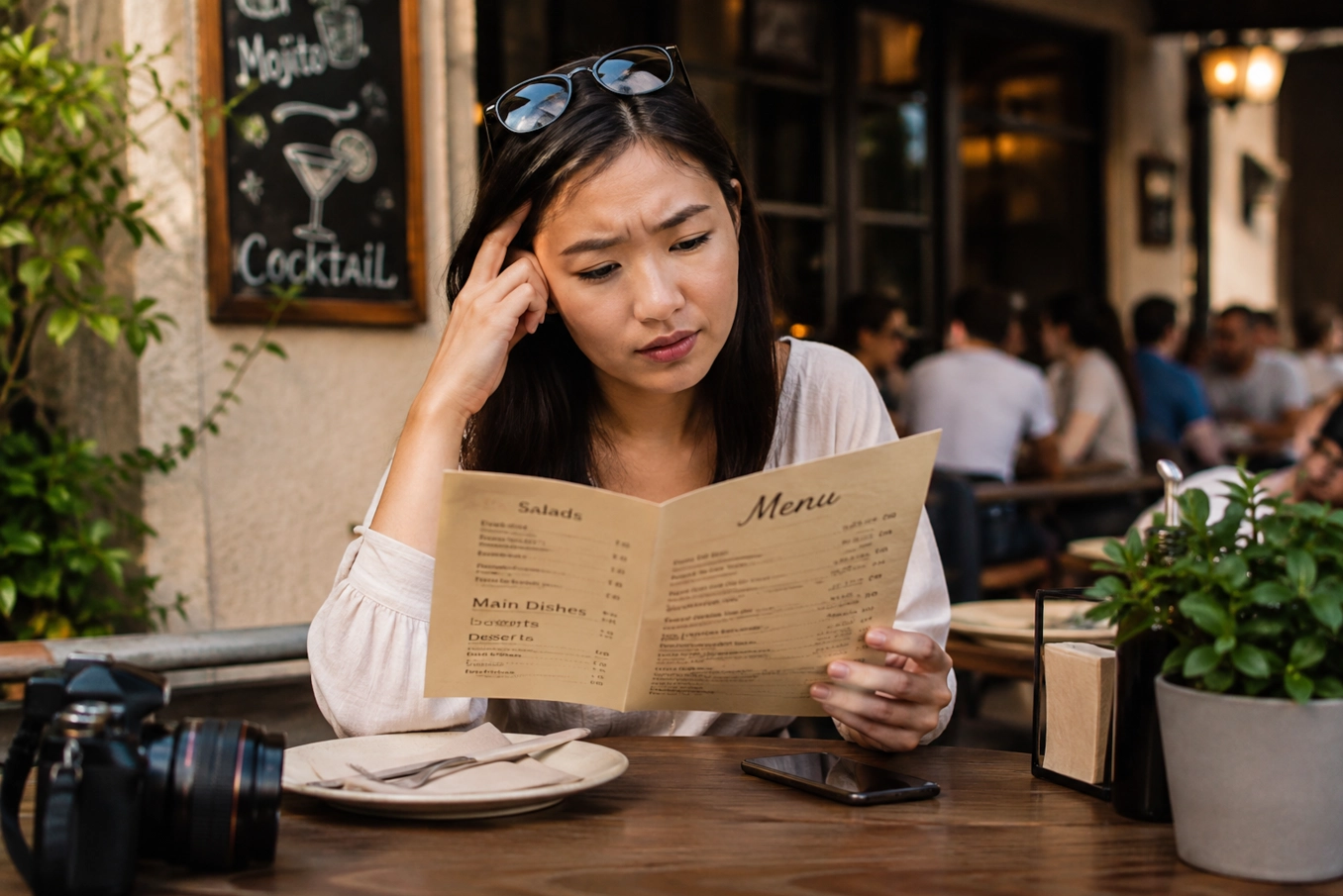
A tourist has a completely different starting point.
They may be asking:
What kind of food is this restaurant known for?
What is a typical local dish?
Is this dish spicy?
What does this ingredient mean?
Is there a photo?
Is this something I would recognize?
What do other people usually order?
Should I try something local or stay with something familiar?
That means the same menu can create very different customer journeys. And those journeys are worth studying.
Country-based personalization starts with understanding behavior
When we talk about personalization, it is tempting to imagine a menu that automatically changes depending on the guest. That's not what we're talking about here.
The restaurant does not need to show one menu to Italians and another to Germans.
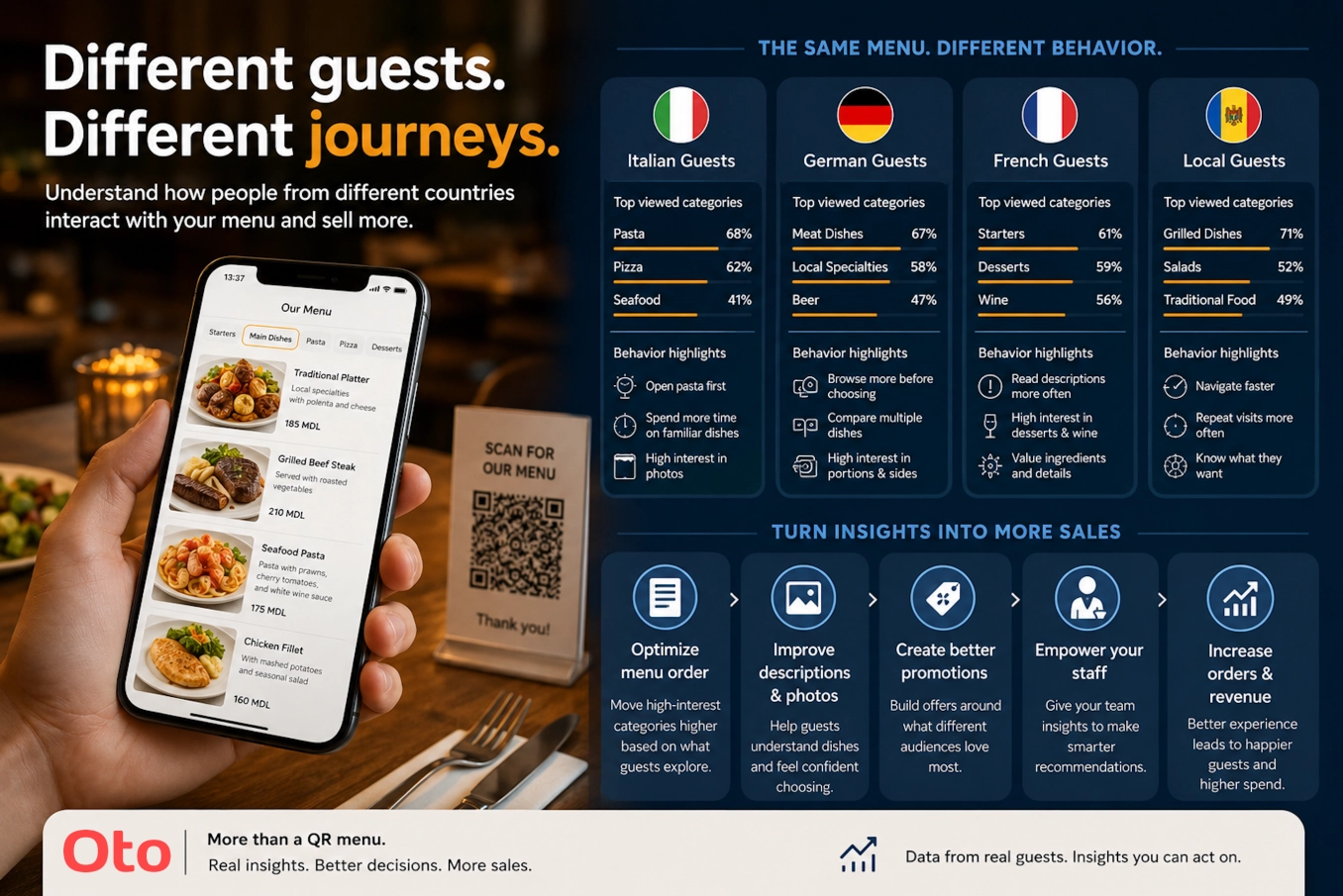
Instead, the restaurant can analyze how different audiences interact with the same menu.
This is an important distinction. The menu stays the same.
The data tells you whether it is working equally well for different audiences.
For example, imagine a restaurant in Chisinau with a large number of international visitors.
After several months of collecting menu behavior, the restaurant discovers:
Most viewed categories
Most viewed dishes
Repeated visits
Interest in familiar dishes
Attention time,
etc.
The restaurant now knows something that a traditional sales report would never show.
It knows what different audiences are interested in before they order.
The first click can be more interesting than the final order
Restaurant owners naturally focus on sales. And of course, sales matter.
But behavioral analytics can reveal what happened before the sale. Imagine that 100 Italian guests visit your restaurant.
Twenty-five of them order pasta. That tells you something. But suppose 70 of them viewed the pasta category.
Now you have a much more interesting signal.
There is clearly strong interest, but not everyone who explored the category ended up ordering.
That raises new questions:
Why did they leave?
Maybe the dishes lacked photos.
Maybe the descriptions were unclear.
Maybe the prices were higher than expected.
Maybe another category caught their attention.
Maybe the pasta dishes were buried below too many other options.
This is why menu analytics should not stop at "dish sold."
The journey matters.
What restaurants can learn about different audiences
A digital menu can create a much richer picture of guest behavior than a printed menu ever could.
For example, restaurants can look for patterns such as:
What does each audience click first?
The first category a guest opens can reveal their initial expectation.
If international visitors consistently open "Local specialties" first, that is a valuable signal.
It could mean that tourists are actively looking for a local experience.
That might influence how the restaurant positions its signature dishes, creates promotions, or trains staff to make recommendations.
Which dishes attract attention but don't convert?
This is one of the most useful patterns to investigate.
A dish can receive hundreds of views but relatively few orders.
That does not necessarily mean the dish is bad.
It could mean that something between interest and purchase is not working.
Maybe the price creates hesitation.
Maybe the description does not explain the dish well enough.
Maybe guests are comparing it with another option.
Maybe the portion information is unclear.
Or maybe the dish simply needs a better presentation.
Which dishes are ignored by specific audiences?
A restaurant may have a great local specialty that sells extremely well with domestic guests but receives almost no attention from international visitors.
That does not automatically mean the dish should be removed.
It could mean international guests don't understand what it is.
A better photo, clearer description, translated ingredients, allergen information, or a stronger explanation of why the dish is special could change that.
How long do different audiences browse?
Time spent in the menu can also tell a story.
A guest who finds what they want immediately behaves differently from someone who spends five minutes jumping between categories.
Longer browsing can mean interest.
It can also mean confusion.
The important thing is to combine time with other actions.
Country-based behavior can change how you promote dishes
Let's take a simple example.
Suppose a restaurant discovers that international guests frequently view a traditional Moldovan dish, but relatively few order it.
The restaurant now has several options.
Instead of simply assuming "foreigners don't like this dish," it can test ways to make the dish easier to understand.
For example:
Traditional dish
Add a strong photo.
Explain the main ingredients.
Mention that it is a local specialty.
Show portion size.
Highlight dietary information.
Give it a clear English description.
Then monitor what happens.
Do views increase?
Does time spent on the dish increase?
Does the number of orders increase?
This is where digital menus become much more interesting.
The restaurant can make a change and observe whether guest behavior changes.
That is much better than redesigning a menu based purely on someone's opinion.
The same insight can help with drinks and desserts
Country-based behavior is not only about food.
Restaurants can discover interesting differences across their drinks, desserts, and extras.
For example, international visitors might show unusually high interest in:
Local wine
Craft beer
Traditional spirits
Signature cocktails
Local desserts
Coffee
Sharing plates
Imagine discovering that tourists consistently view local wine but rarely add it to their order.
That is a potential upselling opportunity.
The restaurant could experiment with:
"Try a local wine with your dinner."
Or train waiters to recommend a specific bottle when they see a table showing interest in local dishes.
The same principle works for desserts.
If one audience frequently opens desserts but rarely orders them, the restaurant may have an opportunity to improve presentation or create a more compelling recommendation.
This is where Oto becomes more than a QR menu
A QR menu is easy to understand.
Scan a code. Open the menu. Browse the dishes.
But that is only the visible part.
Behind those interactions is a behavioral trail.
Oto can help restaurants understand what guests actually do inside the digital menu.
Restaurants can analyze things such as:
Which dishes receive the most views
Which categories attract attention
How long guests spend browsing
Which products are added to the basket
Which actions guests take
What devices they use
When menu activity is highest
Where guests appear to lose interest
How behavior differs between audiences
And country-based behavior adds another layer.
Instead of looking at:
"Our best-selling dish is X."
You can start asking:
"Which dishes attract Italian guests?"
"Which dishes do German guests explore?"
"Which local specialties get the most attention from tourists?"
"Which categories do international guests browse before ordering?"
Those questions lead to much better decisions.
How restaurants can use these insights
The goal is not to collect interesting statistics.
The goal is to use them.
Here are several practical ways.
1. Improve the order of your menu
Oto cannot automatically rearrange dishes based on the guest's nationality.
But the data can tell you whether your current structure makes sense.
If you discover that a category receives huge interest but is buried near the bottom, you have a reason to reconsider its position.
If a signature dish receives very little attention, you can investigate whether it needs better visibility.
2. Create better recommendations for international guests
Your waiters already interact with guests.
Give them better information.
If you know that international visitors frequently explore local specialties, your team can proactively recommend those dishes.
Instead of saying:
"Would you like anything else?"
The waiter can say:
"If you'd like to try something local, our traditional dish is one of the most popular choices."
That is a much stronger sales conversation.
3. Improve translations and descriptions
A dish can lose a sale simply because the guest doesn't understand it.
Behavioral data can help identify which dishes international visitors are interested in but don't order.
That is a good reason to review:
Translation quality
Ingredients
Portion information
Photos
Allergen information
Cooking method
Dish descriptions
Sometimes the problem isn't the food.
It's the explanation.
4. Build promotions around real behavior
Suppose Italian guests frequently view pasta and wine.
Instead of guessing what promotion might work, the restaurant can create a combination around those interests.
The same applies to other audiences.
The point isn't to stereotype guests by nationality.
It is to identify real patterns in your own restaurant.
Your data is more valuable than generic assumptions about what people from a particular country supposedly like.
Don't confuse correlation with a customer stereotype
There is an important rule here.
Country-based analytics should be used to discover patterns, not create rigid assumptions.
If 60% of Italian guests view pasta, that does not mean every Italian guest wants pasta.
If German visitors often explore meat dishes, that does not mean they should be pushed toward meat.
Behavioral analytics should help restaurants understand probabilities, not label people.
The best approach is:
Observe → identify a pattern → test an improvement → measure the result.
That's how menu optimization becomes a process rather than a guessing game.
The biggest opportunity is not changing the menu for every guest
It is understanding why guests behave differently.
This is the real value of country-based menu analytics.
Your restaurant might have thousands of guests every month.
They scan the same QR code.
They see the same categories.
They browse the same dishes.
But underneath that identical experience are hundreds of different customer journeys.
Some guests know exactly what they want.
Some are exploring.
Some are looking for something familiar.
Some want to try something local.
Some are comparing prices.
Some are looking for photos.
Some are searching for dietary information.
And some are simply scrolling until something catches their eye.
The more you understand those journeys, the easier it becomes to improve the menu and sell more.
From menu data to better restaurant decisions
The future of restaurant technology is not simply replacing paper with a QR code.
The more interesting opportunity is what happens after the guest scans it.
A digital menu can become a source of behavioral intelligence.
It can show restaurants:
What guests notice.
What they ignore.
What they compare.
What they add.
Where they stop.
And, importantly, how those behaviors differ between audiences.
That gives restaurant owners something they rarely had with printed menus: a way to see what happens before the order.
And once you can see the behavior, you can start improving it.
Try Oto
Your guests are already telling you what they want.
The question is whether your restaurant is listening.
Oto turns your QR menu into a behavioral analytics tool that helps you understand how guests browse, what they interact with, and which patterns can lead to better sales decisions.
Start building a smarter digital guest experience with Oto:
Frequently asked questions
Can Oto show a different menu to guests from different countries?
No. Oto does not automatically change the position of dishes based on a guest's nationality. Instead, it helps restaurants analyze how different audiences behave when using the same digital menu.
How can restaurants use country-based menu analytics?
Restaurants can compare how guests from different countries browse categories, view dishes, spend time in the menu, and interact with products. These insights can help improve menu structure, descriptions, promotions, and staff recommendations.
Why is menu browsing behavior important if I already know my best-selling dishes?
Sales data tells you what guests bought. Menu behavior can help explain what happened before the purchase. A highly viewed dish with few orders, for example, may indicate a problem with pricing, presentation, descriptions, or positioning.
Can international guests behave differently from local guests?
Yes. Different audiences can have different levels of familiarity with local cuisine, different expectations, and different browsing habits. The important thing is to measure these patterns in your own restaurant instead of relying on assumptions.
What should restaurants measure in a digital menu?
Useful metrics include dish views, category views, time spent browsing, basket additions, guest actions, peak browsing periods, device usage, and behavioral differences between audience groups.
Can menu analytics help restaurants sell more?
Yes. Analytics can identify which dishes attract attention, where guests lose interest, and which products are frequently explored but rarely purchased. Restaurants can then test changes to menu presentation, recommendations, promotions, and descriptions.
Should restaurants create different menus for different nationalities?
Not necessarily. In many cases, it is more practical to keep one well-structured multilingual menu and use behavioral data to understand how different audiences interact with it. The insights can then guide marketing, menu design, and staff recommendations.
What makes Oto different from a basic QR menu?
A basic QR menu mainly provides digital access to dishes. Oto goes further by helping restaurants understand guest behavior inside the menu, turning menu interactions into data that can support better operational and revenue decisions.