Translation isn't just hospitality. It's part of selling
When restaurants think about translating their menu, the conversation often starts with hospitality.
"We want international guests to feel welcome."
That's true, but there's a much more practical reason.
A translated menu gives a guest access to more of what you sell.
Think about what happens when someone reads a menu in a language they don't understand. They can recognize a few ingredients. They might understand some international dish names.
But unfamiliar dishes become difficult to evaluate. And people are naturally cautious when spending money on something they don't understand. This is especially important when the menu doesn't have photos.
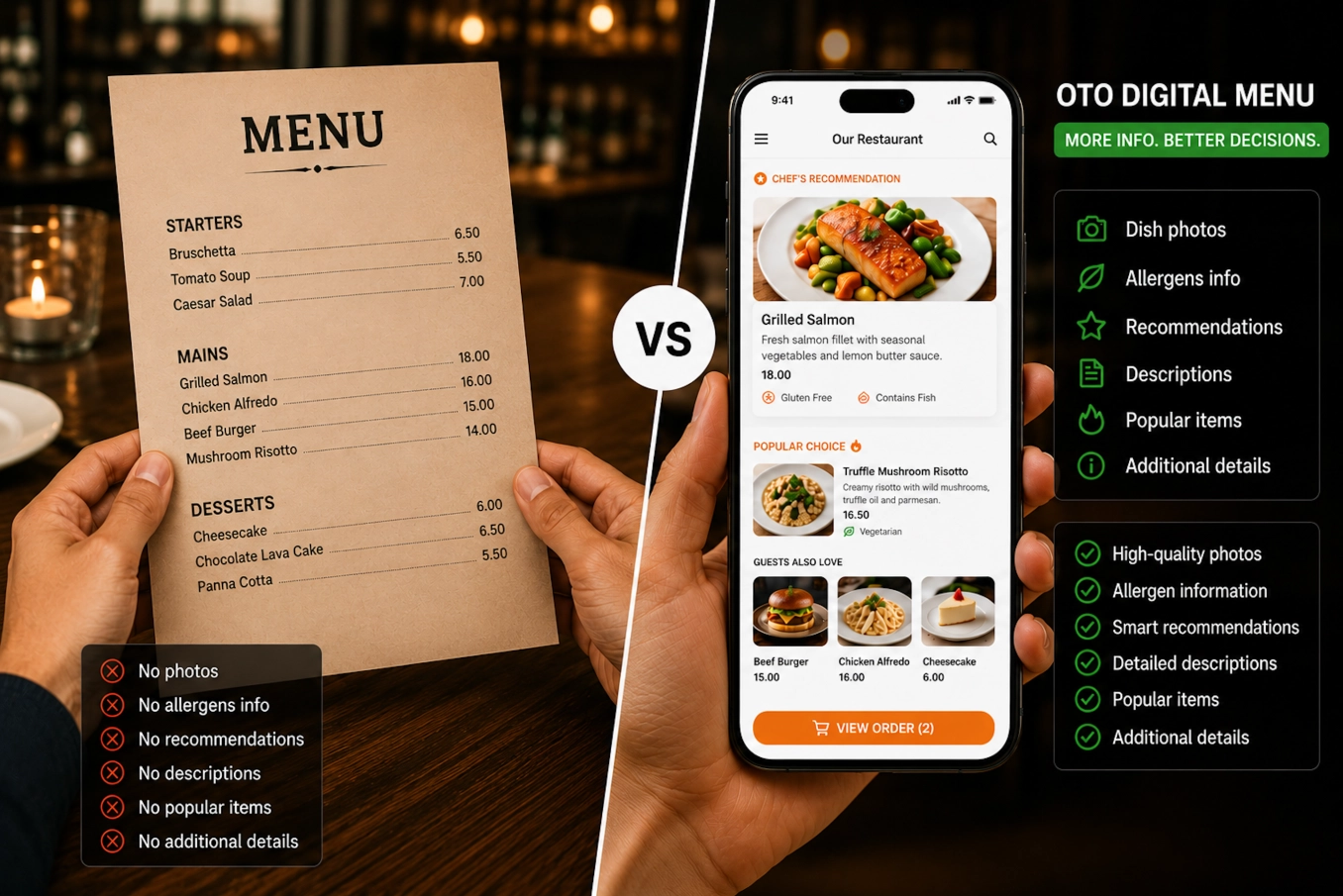
A picture can sometimes communicate the basic idea of a dish immediately. Without one, the guest has to rely almost entirely on the description. If that description is also unavailable in a language they understand, the barrier becomes even bigger.
The restaurant might have an excellent local specialty. The guest might absolutely love it. But they never order it. Not because the dish isn't good.
Because the menu never managed to sell it.
A text-only menu makes translation even more important
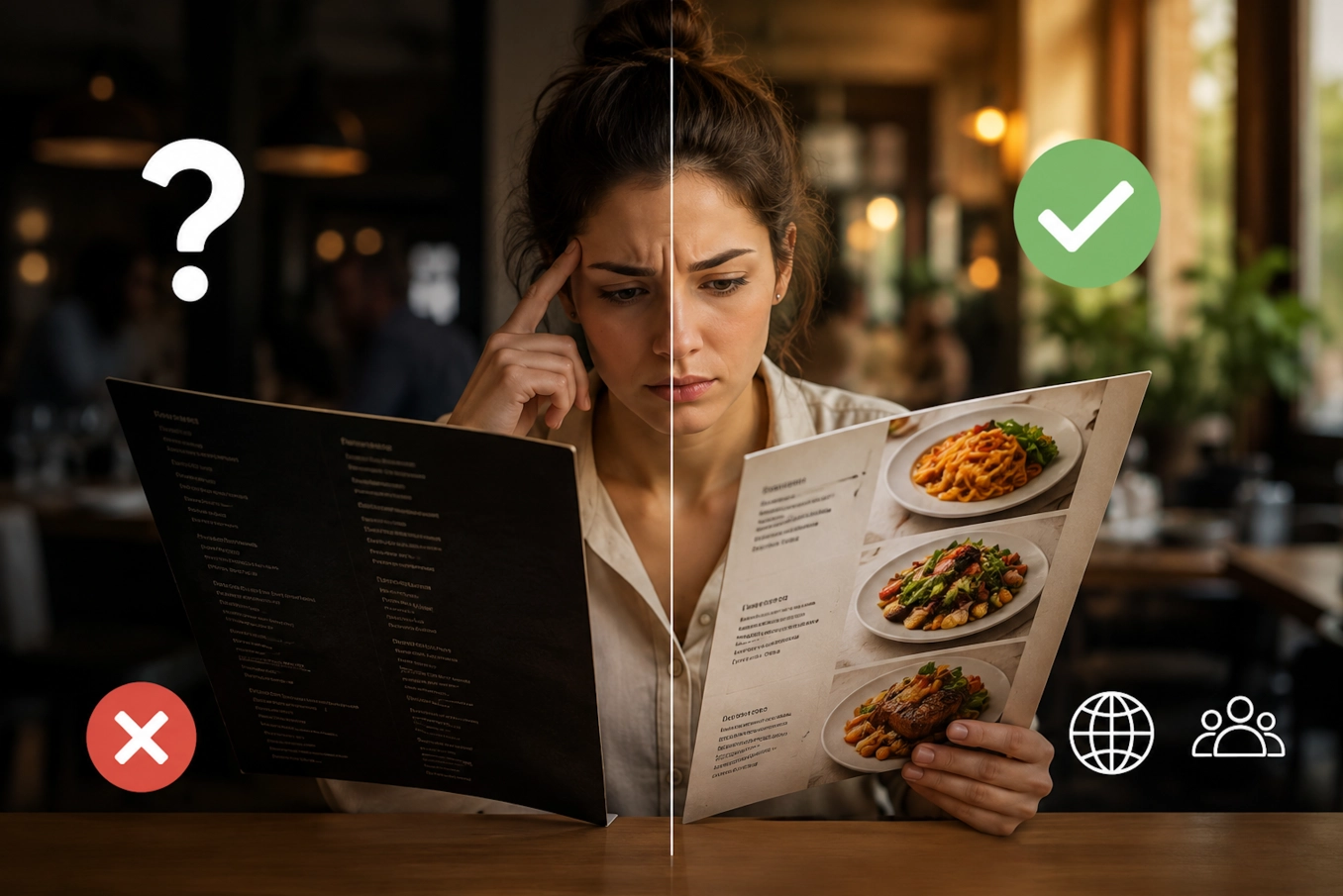
There is a big difference between seeing a dish and understanding a dish. With a visual menu, a guest can often get some idea of what they are ordering from the image. With a traditional text-only menu, almost everything depends on the words.
The name.
The ingredients.
The preparation.
The description.
The portion.
The explanation of what makes the dish special.
If all of this is written in a language the guest doesn't understand, the restaurant has effectively removed one of its most important sales tools. Imagine a menu with 50 dishes. For a local guest, all 50 may be available for consideration.
For an international guest who can't understand the language, perhaps only five or six familiar dishes feel safe.
The restaurant still has 50 dishes. The guest doesn't.
That's the hidden cost of an untranslated menu.
What happens when guests don't understand the menu?
Usually, they don't complain. That's what makes the problem difficult to spot. A guest isn't likely to tell the manager:
"Your menu caused me to spend less."
Instead, they simply make a safer choice.
They might:
Choose a dish they already know
Order what another person at the table orders
Ask the waiter for the most popular option
Skip an unfamiliar category
Avoid local specialties
Ignore premium dishes
Skip desserts because they aren't sure what they contain
Order fewer items overall
None of these actions looks like a problem in isolation. But across hundreds or thousands of international guests, they can have a real effect on revenue. The restaurant isn't only losing individual dish sales.
It may also be losing upselling opportunities.
A guest who understands the menu is more likely to explore. A guest who doesn't understand it is more likely to simplify the decision. And simplified decisions often mean smaller bills.
Translation removes friction from the guest journey
Good restaurant sales don't always come from convincing people to buy more. Sometimes they come from removing the reasons not to buy.
A guest who understands the menu can make a decision faster. They can compare dishes. They can discover something unfamiliar. They can understand ingredients. They can recognize local specialties.
They can choose a starter because they know what it is. They can add a dessert because the description makes sense. They can order a premium dish because they understand why it is different.
That's why multilingual menus should not be treated as a separate "tourist feature."
They are part of the digital guest experience and, ultimately, part of restaurant revenue optimization.
"But we already have a translated menu"
That's a good start. But there are two questions worth asking.
Is it translated well?
A menu translated word-for-word isn't necessarily a good menu. Restaurant terminology can be complicated. Local dishes often don't have a direct equivalent in another language. A useful translation should help the guest understand what they are actually ordering, not simply replace one word with another.
The goal isn't linguistic perfection. The goal is decision-making clarity.
Is it available where guests actually need it?
A restaurant might have several versions of its paper menu hidden somewhere behind the counter. That doesn't necessarily create a smooth experience.
The guest shouldn't have to figure out which version to request. The easier it is to access the right language, the more likely guests are to use it. This is one reason digital menus have an important advantage over traditional printed menus.
Adding another language doesn't require printing another stack of menus.
A multilingual menu can also make your restaurant easier to operate
There is another benefit that is easy to overlook. When guests don't understand the menu, the waiter becomes the translator.
"What's in this?"
"How is this prepared?"
"What's the difference between these two dishes?"
"Is this spicy?"
"What do you recommend?"
Of course, staff should help guests. That's part of good hospitality. But during busy periods, repeating the same explanations dozens of times is inefficient.
A well-structured multilingual digital menu can answer many of these questions before the waiter needs to get involved.
That gives staff more time to do what humans are actually good at:
hospitality, recommendations and personal service.
Restaurant automation shouldn't make service less human. It should remove the repetitive work that gets in the way of human service.
The bigger question: which languages do you actually need?
This is where things get more interesting.
Most restaurants make their language decisions based on assumptions. They choose the languages they think are important. Sometimes those assumptions are correct. Sometimes they aren't.
A restaurant in a tourist destination might have guests from many different countries throughout the year. Their visitor mix can change with seasons, events, flights, tourism trends and local attractions.
So instead of asking:
"Which languages should every restaurant have?"
A better question is:
"Which languages do my guests actually need?"
This is where restaurant data becomes useful.
How Oto helps restaurants discover missing languages
Oto doesn't just provide a digital menu in multiple languages. It can also give restaurants insight into where their menu visitors are coming from.
This helps a restaurant see the nationalities and tourist audiences interacting with its menu. The value isn't in knowing that a particular person visited. The value is seeing the broader pattern.
For example, a restaurant may discover that a meaningful share of its international visitors comes from a market it hadn't considered before. Now the owner has a much better question to answer:
"Do we have a menu in the language these guests understand?"
If the answer is no, the opportunity is obvious.
And with Oto, the restaurant can add another language in just a few clicks instead of rebuilding and reprinting its entire menu. That's a very different approach from simply deciding once a year which languages "seem useful."
The restaurant can adapt its menu to the guests it is actually attracting.
From a static menu to a menu that learns
This is one of the biggest differences between a traditional paper menu and a modern digital menu.
A paper menu is static. You print it. You put it on the tables. And that's essentially where the story ends.
You don't know which dishes guests considered.
You don't know which descriptions they read.
You don't know which languages they needed.
You don't know which parts of the menu created friction.
A digital menu can provide a much richer picture.
You can start with a simple question:
Who is visiting us?
Then move to:
What are they looking at?
Then:
What are they ordering?
And eventually:
What can we change to make the next guest more likely to buy?
That's the foundation of a more intelligent digital guest experience.
Don't translate everything blindly. Remove the biggest barrier first.
Restaurants sometimes overcomplicate the idea of multilingual menus.
They think they need to translate everything into every possible language.
They don't.
Start with the languages that matter to your business.
If international guests represent an important part of your customer base, make it easy for them to understand the food you are selling.
If your menu is currently text-only, consider adding photos to your most important dishes as well.
If you already have a digital menu, look at which languages your guests actually need.
And if you don't know, start collecting the data.
The objective isn't to create a menu with an impressive number of flags.
The objective is to help more guests confidently answer one simple question:
"What should I order?"
When the answer becomes easier, more of your menu becomes sellable.
The real cost of not translating your menu
Restaurants often calculate the cost of translation.
How much will it cost to translate the menu?
How much will it cost to redesign it?
How much will it cost to print new versions?
Those are reasonable questions.
But there is another calculation that rarely gets made:
How much revenue are we losing because international guests don't understand what we're selling?
If a guest skips three dishes because they can't understand them, that's lost revenue.
If they choose a cheaper familiar dish instead of a premium local specialty, that's lost revenue.
If they skip a starter or dessert because they aren't sure what it is, that's lost revenue.
If the waiter spends several minutes explaining the menu instead of serving another table, that's an operational cost.
And if this happens every day, the numbers add up.
Translation is therefore not simply an expense.
For restaurants serving international guests, it can be a sales tool.
The future of restaurant menus is not just digital. It's adaptive.
The first step is getting away from the idea that a menu is simply a list of dishes and prices.
Your menu is part of your sales process.
It introduces the food.
It explains unfamiliar dishes.
It reduces uncertainty.
It helps guests make decisions.
And when it is digital, it can also give the restaurant information about how that sales process is working.
Translation is one of the simplest improvements a restaurant can make.
Especially when the alternative is asking an international guest to choose from a text-only menu they can't fully understand.
You can't sell a dish a guest never understands.
And you can't improve the experience for international guests if you don't know who those guests are.
That's where multilingual digital menus and restaurant analytics start working together.
Try Oto
If your restaurant welcomes international guests, don't make them guess what your menu means.
With Oto, you can create a multilingual digital menu, update it without reprinting, provide richer dish information and understand more about the international audiences visiting your restaurant.
You can also use visitor nationality insights to identify which languages may be missing from your menu and add them when the data shows a real opportunity.
Make more of your menu understandable. Make more of your menu sellable.
FAQ
Why does a restaurant need a translated menu?
Because international guests cannot confidently order dishes they don't understand. Translation removes a major barrier to discovering unfamiliar dishes and can help restaurants increase the number of menu items guests consider.
Is translation still important if the menu has photos?
Yes. Photos can help guests understand what a dish looks like, but they don't explain everything. Guests may still need to know the ingredients, preparation method, portion or other details before ordering.
Should restaurants translate their menu into every language?
Not necessarily. Restaurants should prioritize the languages that are relevant to their actual guests. Visitor data can help identify which international audiences are most important.
How can restaurants know which languages their guests need?
Restaurant analytics can reveal where menu visitors are coming from and which international audiences are engaging with the menu. This can help identify languages that may be worth adding.
Can a digital menu increase restaurant sales?
A digital menu doesn't automatically increase sales, but it can remove friction from the ordering process. Better descriptions, translations, photos, recommendations and behavioral insights can help guests discover and confidently order more dishes.
What is the advantage of a multilingual digital menu over a printed menu?
A digital menu can be updated instantly, support multiple languages without printing separate versions and provide insights into how guests interact with it. Restaurants can adapt the menu as their customer base changes.
Can Oto show which nationalities are visiting a restaurant?
Yes. Oto can provide restaurants with insights into the nationalities and international audiences visiting their digital menu. This can help restaurants identify potential gaps in their language coverage.
How quickly can a restaurant add another language with Oto?
Oto allows restaurants to add languages to their digital menu in just a few clicks, making it much easier to adapt the menu when the guest mix changes.
Is a multilingual menu useful only for tourist restaurants?
No. Any restaurant that regularly receives international guests can benefit from multilingual menu options. This includes restaurants near hotels, airports, attractions, business districts, transport hubs and international events.
What is the biggest mistake restaurants make with international guests?
One of the biggest mistakes is assuming that a guest who can recognize a few words can understand the entire menu. A guest may be able to order familiar dishes while completely ignoring most of the restaurant's menu because they don't understand it.