The problem: Menu changes feel dangerous
Restaurant owners know menus should evolve. Seasonal dishes change. Customer preferences shift. Food costs move.
Competitors introduce new concepts. But many restaurants delay improvements because they fear breaking something that already works. And honestly, that fear makes sense.
Move your best-selling dish too low → orders drop.
Change descriptions too aggressively → guests stop engaging.
Add too many options → decision fatigue appears.
Traditional printed menus make testing expensive.
You print, replace, wait, and hope.
Digital menus and contactless ordering change that completely.
Now you can improve continuously without rebuilding the whole guest experience.
Rule #1: Never change everything at once
One of the biggest mistakes restaurants make is launching a complete menu redesign.
New photos.
New categories.
New descriptions.
New pricing.
Then sales move and nobody knows what caused it.
Instead:
Change one variable at a time.
Examples:
Move one category higher
Replace photos for only 3 dishes
Rewrite descriptions for selected items
Highlight one signature item
Test shorter dish titles
Change category order
Small experiments create reliable insights.
Large changes create confusion.
Rule #2: Start with visibility, not products
Most restaurants assume low-performing dishes are unpopular. Often they’re simply invisible.
Imagine a guest opening your menu. If they never scroll to appetizers… No one can conclude appetizers are weak. Before removing dishes, test visibility.
Questions to ask:
Are guests opening this category?
How long do they stay?
Which dishes receive views but no orders?
Which dishes are ignored entirely?
Sometimes moving a dish up produces more impact than creating a new one.
Rule #3: Measure behavior before measuring sales
Sales tell you what happened. Behavior tells you why. That difference matters.
Example: You replace a dessert photo. Orders stay flat. Looks like the test failed.
But analytics show:
Dessert views increased 40%
More guests opened dessert pages
Guests spent longer browsing
That means interest improved, but maybe pricing or positioning still needs work.
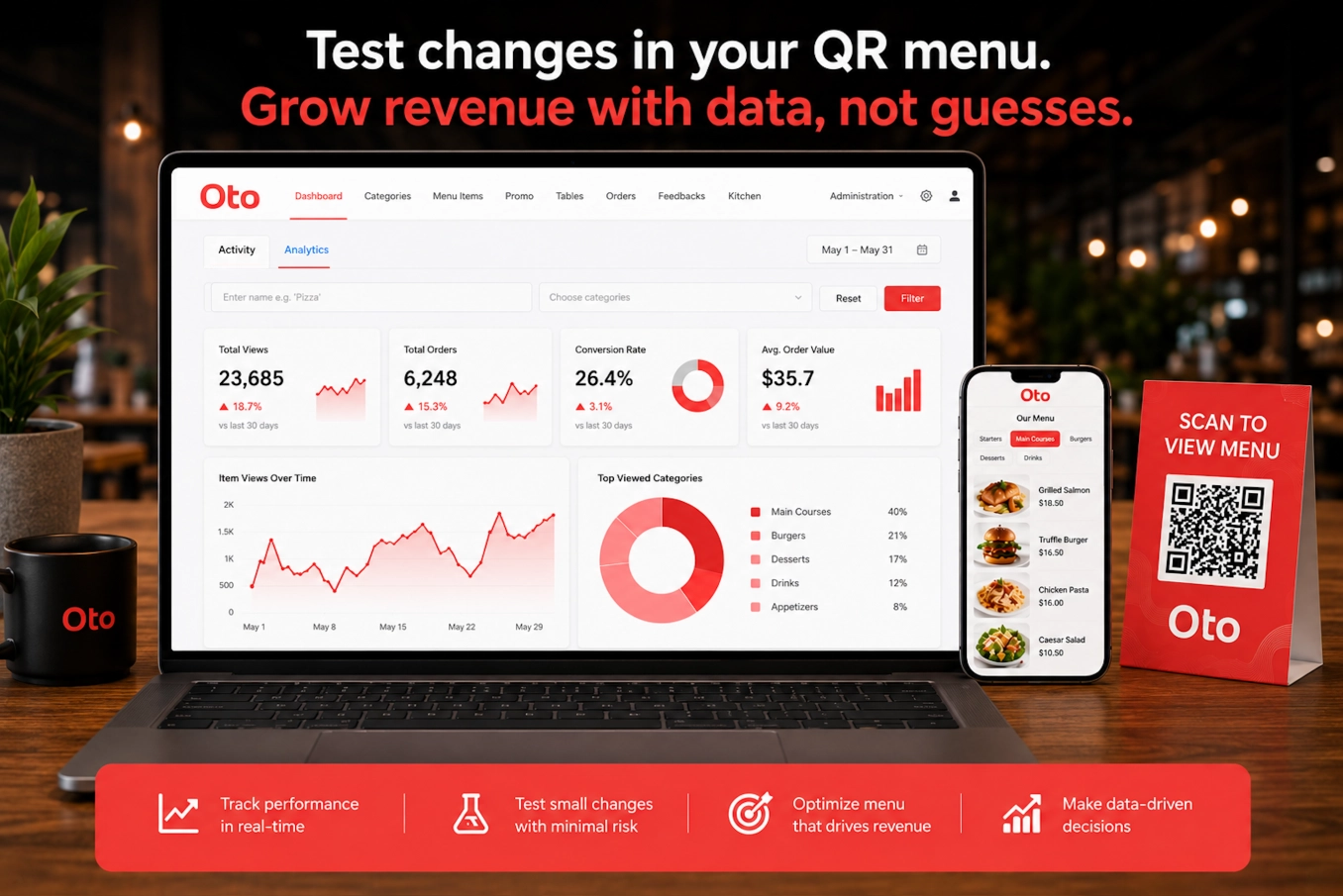
Good QR menu testing tracks signals such as:
Menu opens
Category engagement
Dish views
Scroll depth
Time spent per section
Conversion from view to order
This is where menu analytics become more valuable than simple sales reports.
Rule #4: Run short testing cycles
Restaurants often wait too long. They make one change. Then leave it untouched for six months.
Instead: Use short cycles.
A simple process:
Week 1
Record baseline performance.
Week 2
Introduce one change.
Week 3
Compare results.
Week 4
Keep, improve, or reverse. Small cycles reduce risk. You don’t need perfect certainty. You need continuous improvement.
Rule #5: Protect your best performers
Not every dish should enter experiments. Identify your stable performers first.
Protect:
High-margin dishes
Signature dishes
Consistent top sellers
Popular bundles
Experiment around them.
Test:
Supporting dishes
New arrivals
Seasonal offers
Underperforming sections
Think of your menu like a football team. You don’t replace all your strongest players before a match.
The Oto approach: Test without disrupting service
At Oto, we built the platform around a simple reality:
Restaurant teams are busy. Nobody wants spreadsheets, manual tracking, and complicated dashboards.
That’s why Oto helps restaurants improve menus through real guest behavior.
With Oto, restaurants can:
Update menus instantly
Rearrange categories in minutes
Add or replace photos
Track menu engagement
Understand what guests actually open and view
Optimize decisions using behavioral analytics
Instead of asking:
“Do we think this works?”
You start asking:
“What did guests actually do?”
That shift changes everything.
Real examples of low-risk menu tests
Here are a few experiments restaurants can run this week:
Test #1: Move high-margin items higher
Measure:
Views
Orders
Revenue per guest
Test #2: Add photos to selected dishes only
Measure:
Click-through rate
Conversion
Test #3: Rewrite descriptions
Replace:
“Grilled chicken with vegetables”
With:
“Flame-grilled chicken served with seasonal vegetables and herb butter”
Measure:
Engagement
Orders
Test #4: Highlight staff favorites
Measure:
Item discovery
Basket value
The biggest mistake: Waiting for certainty
No restaurant owner knows the perfect menu. The best restaurants learn faster than competitors. That doesn’t mean making reckless changes. It means making controlled improvements.
One decision. One insight. One test at a time.
Your QR menu should not be a digital copy of a printed menu. It should become a system that helps you discover what guests actually want.
Try Oto
Stop guessing what guests want.
Start testing menu changes safely and improve decisions with real customer behavior.
FAQ
How often should restaurants update their QR menu?
Small improvements every 2–4 weeks work better than major redesigns every few months.
Can changing a QR menu reduce sales?
Yes, if multiple changes happen at once. Controlled testing reduces this risk.
What should restaurants test first?
Start with item visibility, photos, descriptions, and category order before changing pricing.
What metrics matter most for QR menu optimization?
Dish views, category engagement, time spent, conversion rate, and average order value.
Do QR menus help increase restaurant revenue?
When combined with analytics and continuous optimization, QR menus can help improve discovery and influence ordering behavior.