Language alone tells you very little
A guest choosing French instead of English does not automatically tell you whether they are a tourist, how much they intend to spend, or what they want to eat.
That would be an assumption.
But combine language choice with behavior and the picture becomes more interesting.
Did the guest spend 40 seconds or six minutes in the menu?
Did they open one category or five?
Did they go directly to a familiar product, or explore local specialties, wine, desserts, and premium dishes?
The useful insight is not:
“French-speaking guests behave like this.”
It is:
“Guests using the French version of our menu are interacting with it differently.”
That is something an operator can investigate.
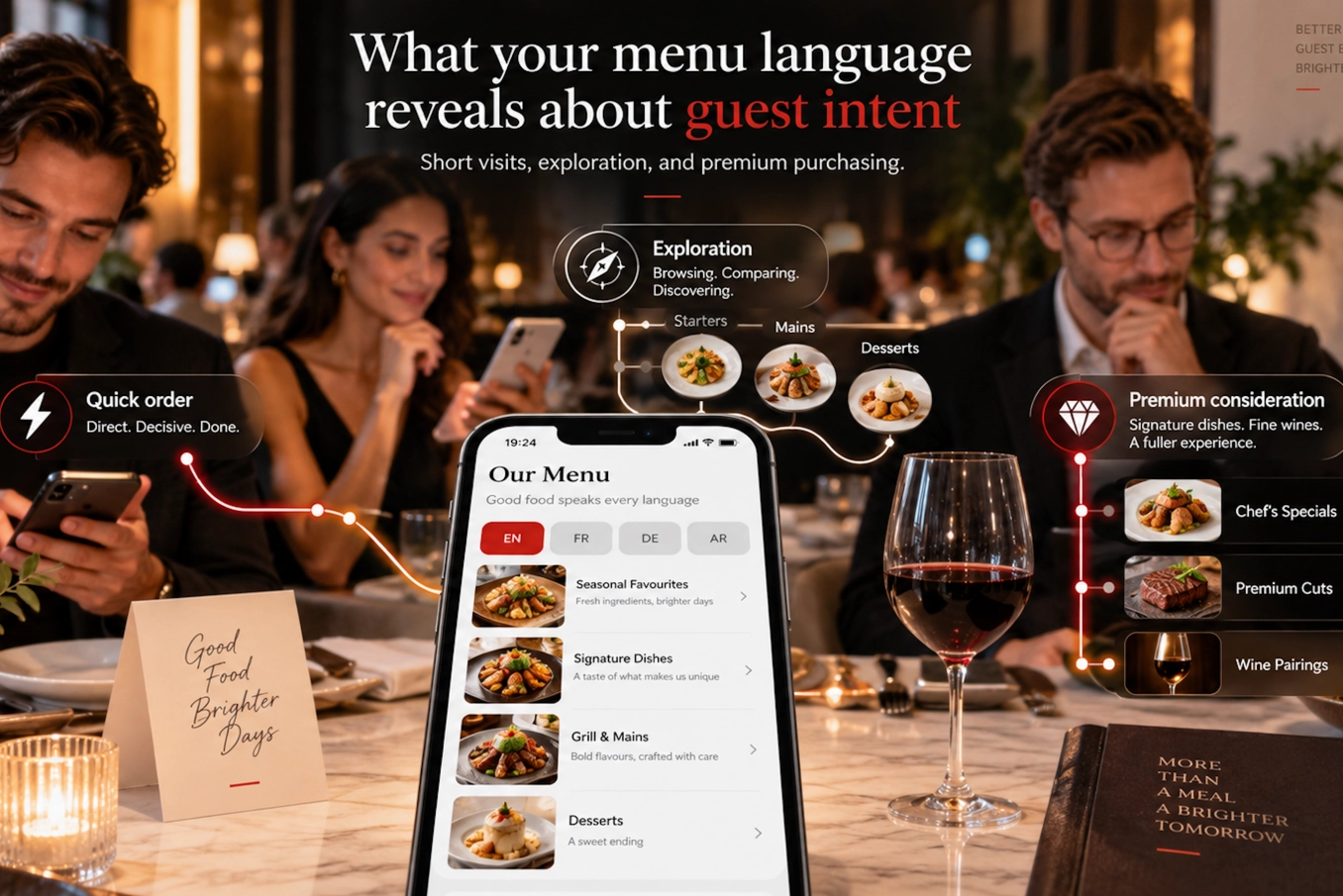
Signal 1: The short visit
Imagine a guest opens your menu, changes the language, views one category, checks two dishes, and makes a decision quickly.
A short visit does not necessarily mean poor engagement.
The guest may already know what they want. They may have visited before. They may be having a quick lunch. Or your menu may simply have made the decision easy.
For an operator, the interesting question is what happens next.
If short sessions regularly lead to orders, your menu may be doing its job efficiently.
If guests repeatedly open a translated menu and leave without exploring or ordering, something else may be happening. Perhaps descriptions are unclear. Perhaps the dishes they are looking for are difficult to find. Perhaps the translation gives them enough information to understand the product, but not enough confidence to choose it.
The session length is only the beginning of the story.
Signal 2: The explorer
Now consider another guest.
They switch the menu language and start moving.
Starters. Local dishes. Main courses. Drinks. Desserts.
They open descriptions, look at several dishes, go back to a previous category, and continue browsing.
This behavior may indicate something very different from the quick visit.
The guest could be discovering your cuisine rather than simply looking for food.
And that matters commercially.
Guests who are exploring give you more opportunities to influence the decision. Good photos can help unfamiliar dishes feel less risky. Clear descriptions can explain ingredients and preparation. Logical categories can make discovery easier.
For a restaurant serving international guests, this is particularly interesting.
A translated menu should not simply help someone understand the words. It should give them enough confidence to explore.
Signal 3: Premium consideration
There is another behavior worth watching.
A guest switches to their preferred language and starts opening your higher-value categories.
Signature dishes. Premium wines. Tasting menus. Specialty cocktails. Chef recommendations.
This does not mean the guest will necessarily buy something expensive.
But it does show consideration.
And consideration is valuable information.
Imagine that a premium steak receives many views from guests using a particular language version, but relatively few orders follow.
That gap raises useful questions.
Is the description convincing?
Are ingredients and portion sizes clear?
Does the guest understand what makes the dish special?
Would a stronger photograph help?
Is the translation communicating the same experience as the original description?
Sales data tells you what was purchased.
Menu behavior can help you understand what was considered before the purchase.
Stop looking at translation as a checkbox
For years, multilingual menus have often been treated operationally.
English version? Done.
German version? Done.
Romanian version? Done.
But a digital menu creates another possibility.
Instead of simply asking whether a language exists, you can start asking how guests behave when using it.
Look at patterns such as:
time spent browsing;
number of categories explored;
dishes viewed;
interaction with premium categories;
movement between categories;
products considered before ordering;
whether different language versions show noticeably different journeys.
You are not trying to predict an individual guest from their language.
You are trying to find patterns in how groups of menu sessions behave.
That distinction is important.
Your menu can become a behavioral sensor
A paper menu cannot tell you which dish someone considered for 30 seconds before choosing something else.
A basic PDF menu cannot tell you whether international guests spend most of their time exploring local specialties.
A digital menu can make parts of that invisible journey visible.
This is where Oto becomes more than a way to put a menu behind a QR code.
Oto gives hospitality businesses a multilingual digital menu while also helping operators understand how guests interact with it.
That creates a different type of conversation inside the restaurant.
Instead of:
“We think tourists prefer this.”
You can start asking:
“What are guests actually doing?”
And that is a much better place to make decisions from.
The real value is in the combination
Language does not reveal intent on its own.
Browsing time does not reveal intent on its own.
A dish view does not reveal intent on its own.
But together, these signals can start showing recognizable journeys.
Quick decision.
Exploration.
Premium consideration.
Once you can see those journeys, your menu stops being only a list of products.
It becomes another source of customer intelligence.
See what happens before the order
Give guests a menu they can comfortably explore in their preferred language, then start learning from how they use it.
Button: Register on Oto
Destination: Register on Oto
FAQ
Can menu language really reveal guest intent?
Not by itself. Language becomes more useful when combined with signals such as session duration, categories viewed, dishes explored, and ordering behavior. Together, these patterns may indicate different types of guest journeys.
Does a short menu session mean the guest is not interested?
No. A short session may mean the guest already knows what they want, is a repeat visitor, is short on time, or simply found their choice quickly. The outcome of the session matters as much as its length.
Can restaurants identify premium purchasing intent?
Restaurants can look for signals of premium consideration, such as repeated interaction with signature dishes, wines, tasting menus, or other higher-value categories. These signals show interest, not a guaranteed purchase.
Why are multilingual digital menus useful for analytics?
They allow restaurants to compare how guests using different language versions navigate and interact with the menu. This can help operators identify friction, improve descriptions, and understand which parts of the menu attract attention.