Your menu speaks differently to different guests
Menu language does more than describe food.
Words such as "quick," "classic," "signature," "chef's choice," "local," "premium," or "for sharing" give guests shortcuts for making decisions.
A guest looking for a fast lunch responds differently to:
Quick lunch
Grilled chicken, fries and salad. Ready in minutes.
than someone in exploration mode:
Discover our local specialties
Traditional recipes prepared with local ingredients.
Or a guest considering a premium purchase:
Chef's signature steak
Dry-aged beef, grilled to order and served with our house sauce.
The food might all be excellent. But the language tells different guests what kind of decision they are being invited to make.
This matters because not every menu session should be optimized for the same behavior.
Three types of menu behavior
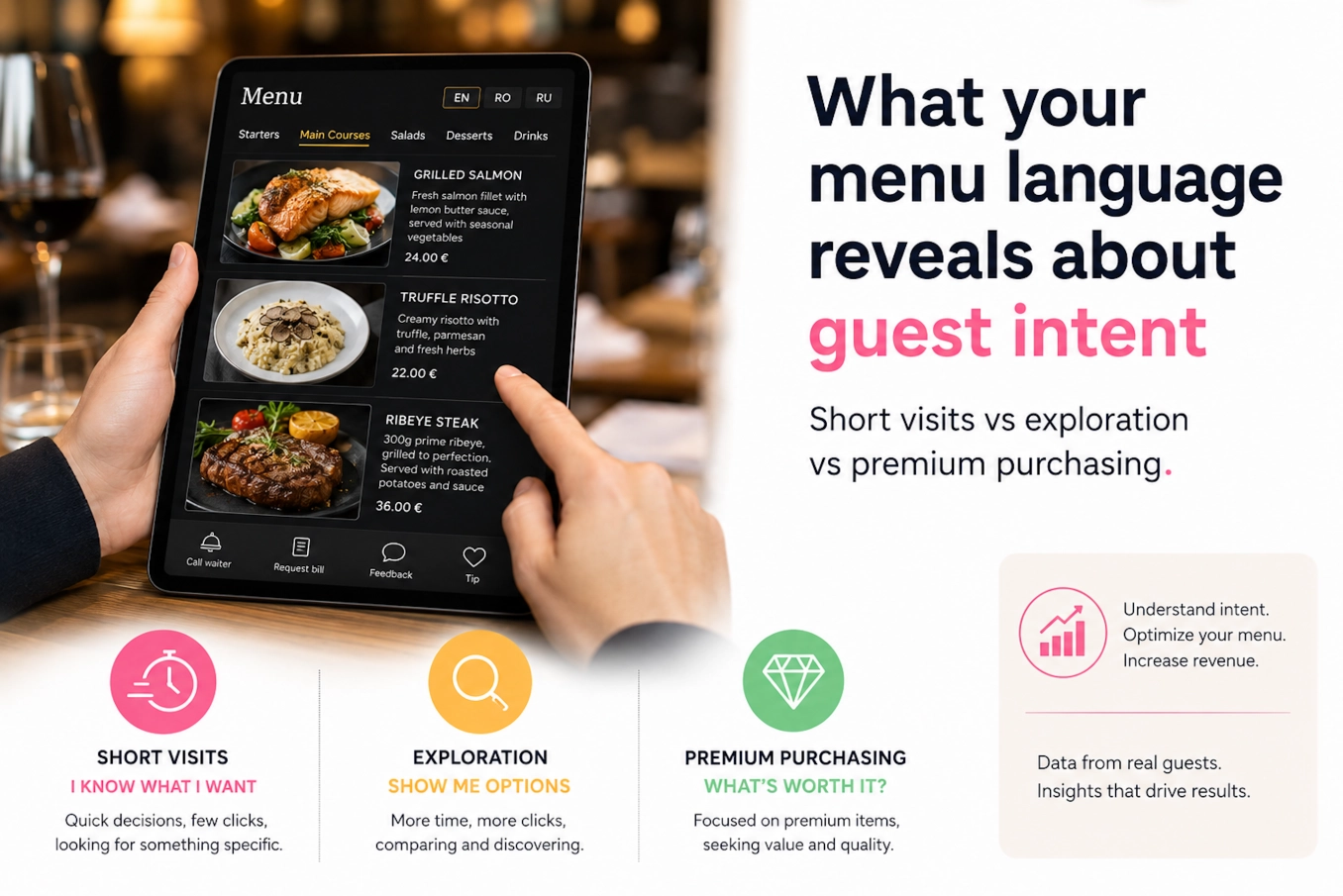
There is no perfect universal classification of guests. But when you look at how people interact with a digital menu, three useful patterns appear repeatedly.
1. The short visit: "I already know what I want"
Some guests barely browse.
They open the menu, find a familiar dish, and leave.
The session might be short. There may be very few item views. The guest may not open descriptions or explore other categories.
This isn't necessarily a bad thing.
A short session can mean:
The guest knows the restaurant well.
They already know what they want.
They are in a hurry.
The menu makes the decision easy.
They are simply looking for one specific item.
For these guests, complicated menu design can actually hurt.
If someone wants a burger, making them scroll through five promotional sections before reaching burgers doesn't create exploration. It creates friction.
This is where language such as "quick lunch," "classics," "most ordered" or "ready in minutes" can be useful.
The goal is not to force every guest to browse more.
Sometimes the best menu experience is helping a guest decide faster.
2. The explorer: "Show me what you have"
Then there is the guest who keeps browsing.
They open several categories.
They read descriptions.
They compare dishes.
They return to items they previously opened.
They may switch between starters, mains, drinks and desserts before deciding.
This behavior can mean uncertainty. But it can also mean opportunity.
The guest hasn't arrived with a fixed decision. They are giving your menu a chance to influence them.
This is where descriptive language becomes much more valuable.
Compare:
Sea bass
with:
Mediterranean sea bass, grilled whole with lemon, herbs and roasted vegetables
The second version gives the guest more information to work with.
Even better, you can use language that creates a reason to explore:
Local specialty
Chef's signature
Perfect for sharing
Guest favorite
Seasonal
Try it with...
Our most popular dessert
These aren't just decorative labels.
They reduce the mental effort required to decide what is worth opening.
And for an exploratory guest, reducing uncertainty can increase discovery.
3. The premium buyer: "What is worth spending more on?"
The third pattern is particularly interesting.
Some guests naturally gravitate toward higher-priced categories.
They open steaks, seafood, premium wines, cocktails, tasting menus or specialty dishes.
They may spend more time reading descriptions because the decision carries more financial weight.
Here, menu language has a different job.
A premium item shouldn't simply be presented as:
Steak - €42
The guest needs to understand why it costs €42.
Where does it come from?
How is it prepared?
What makes it different?
What comes with it?
Why is it worth choosing over the €24 alternative?
Premium purchasing depends heavily on perceived value, not just price.
Good descriptions give the guest a reason to move up.
The same words can create very different behavior
This is where restaurant menu design gets interesting.
Consider three versions of the same category:
Lunch specials
Our most popular dishes
Chef's signature selection
Each one creates a different expectation.
"Lunch specials" suggests speed and practicality.
"Most popular dishes" reduces uncertainty through social proof.
"Chef's signature selection" suggests discovery and higher perceived value.
None of these is objectively better.
The right choice depends on what you want the guest to do.
That is why copying another restaurant's menu structure is often a mistake.
Their guests may have completely different intent.
Language can reveal intent, but behavior confirms it
This is an important distinction.
You shouldn't assume that someone who spends five minutes in a menu is about to spend a lot.
They might simply be confused.
Likewise, someone who spends 20 seconds might be a high-value regular who already knows exactly which premium dish they want.
That's why language should not be analyzed in isolation.
Look at the combination of:
Session duration
Categories opened
Dishes viewed
Description opens
Language selected
Add-to-basket actions
Premium item interactions
Movement between categories
Final conversion
The interesting insight isn't:
"This guest spent four minutes in the menu."
It's:
"Guests who spend four minutes tend to explore three categories, open premium dishes and add starters more often."
Now you have something you can act on.
The biggest mistake: treating browsing as one metric
Restaurants often want one simple answer:
"How long do guests spend in our menu?"
Useful, but incomplete.
Averages hide behavior.
Imagine two restaurants with an average menu session of three minutes.
Restaurant A:
Most guests open one or two dishes and order quickly.
Restaurant B:
Some guests order immediately while others browse ten or fifteen dishes before deciding.
Same average.
Completely different behavior.
The second restaurant may have a much bigger opportunity to understand where exploration turns into purchasing, and where it stops.
This is why behavioral data becomes more valuable when it is segmented.
Language creates the path, behavior shows where guests go
Think of your menu as a conversation.
The language is what you say first.
The guest's interactions are their response.
You write: "Discover our local specialties."
The guest opens three local dishes. That's a signal.
You write: "Perfect for sharing."
Guests start opening larger portions and combination dishes. Another signal.
You highlight: "Chef's signature."
Guests view the item frequently but rarely add it. That's a very different signal.
It might mean the item is attractive but too expensive.
It might mean the description isn't convincing.
It might mean guests don't understand the portion.
It might mean the photo looks better than the actual value proposition.
Sales data alone won't tell you this.
Menu behavior can give you the missing context.
Different languages can reveal different intent
This becomes even more interesting in restaurants with international guests.
A local guest may recognize a dish immediately.
A foreign guest may need to open the description, check ingredients, look at the photo and compare alternatives.
The same menu can therefore produce very different browsing behavior depending on the guest's language and familiarity with the cuisine.
A translated menu isn't just a hospitality feature.
It can change how much of your menu a guest is willing to consider.
For example, a tourist may ignore an unfamiliar local dish when the description is unclear. Give them a useful explanation in a language they understand, and suddenly that dish becomes a realistic choice.
The language removes uncertainty.
The behavior tells you whether it worked.
What restaurants should actually look for
Instead of asking only "What sells?", start asking better questions.
Which guests decide immediately?
This can help you identify your strongest familiar or habitual choices.
Which guests explore the most?
This can reveal where recommendations, photos and descriptions have the greatest influence.
Which dishes attract attention but don't convert?
These may have a pricing, positioning or communication problem.
Which premium dishes receive repeated attention?
These could be strong candidates for better positioning or recommendations.
Do different language groups behave differently?
This can reveal where translation, photos or cultural context are affecting confidence.
Where do guests stop browsing?
This may reveal a menu section that is poorly structured or simply not compelling enough.
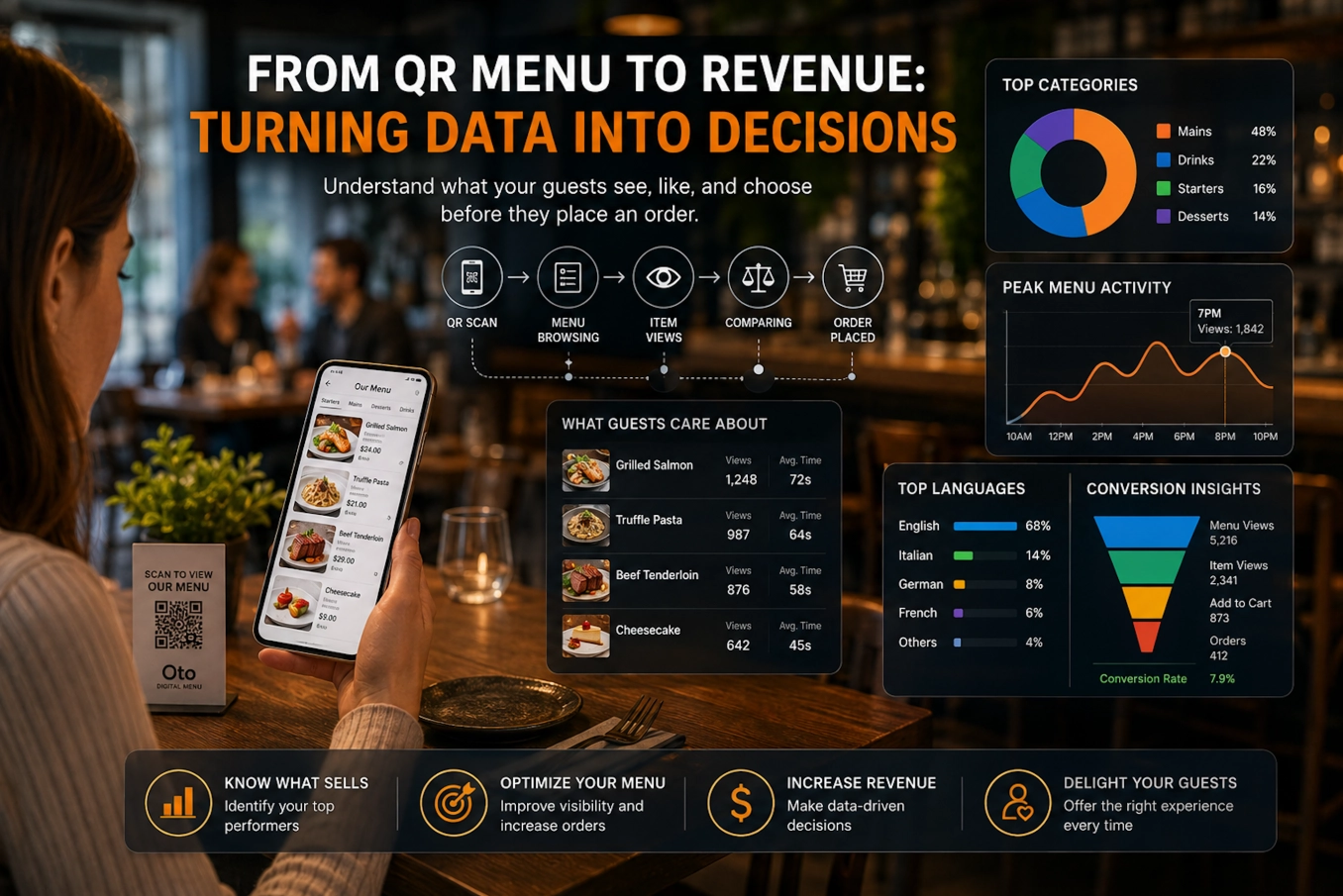
These are much more useful questions than simply counting menu scans.
Your menu should have different jobs
The best menu doesn't force every guest through the same journey.
It should make the obvious choice easy.
It should make exploration rewarding.
And it should make premium choices understandable.
For the quick decision-maker:
Find it fast.
For the explorer:
Give me something interesting to discover.
For the premium buyer:
Show me why it's worth more.
That's three different jobs from the same menu.
And modern digital menus can support all three.
Your menu already influences guest intent
The question isn't whether your menu affects what guests buy.
It does.
The more interesting question is whether you understand how.
Short sessions, deep exploration and premium browsing are not just engagement metrics. They can be clues about what guests came to do and how confident they feel about doing it.
And the words you use can either help that decision or get in its way.
A good menu doesn't simply tell guests what is available.
It helps each guest find the decision they are ready to make.
Try Oto
If you want to understand what guests actually do inside your menu, Oto turns menu interactions into behavioral insights.
You can see what guests open, what they explore, where they engage, which items attract attention, and how different audiences interact with your menu.
Instead of asking your team what they think guests want, start looking at what guests actually do.
FAQ
What can menu language reveal about guest intent?
Menu language can influence whether guests make a quick decision, explore different options, or consider premium products. Words such as "quick," "signature," "local specialty," "most popular" and "premium" create different expectations and can guide browsing behavior.
What does a short menu session mean?
A short menu session can indicate that a guest already knows what they want, is familiar with the restaurant, or is in a hurry. It is not automatically a sign of low engagement.
Does a long menu session mean a guest will spend more?
Not necessarily. Long browsing can indicate exploration, but it can also indicate confusion or difficulty making a decision. Session duration is more useful when combined with dish views, category interactions and purchasing behavior.
How can restaurants identify premium purchase intent?
Restaurants can look for repeated interactions with higher-priced categories and products, longer attention to premium dishes, and whether those interactions lead to basket additions or purchases.
Why does menu language matter for premium dishes?
Premium dishes usually require a stronger value explanation. Descriptions that communicate origin, ingredients, preparation and what makes an item distinctive can help guests understand why a higher price is justified.
Can different languages affect menu behavior?
Yes. Guests who are unfamiliar with the restaurant's cuisine may need more information before making a decision. Providing clear translations and useful descriptions can reduce uncertainty and increase exploration.
What is the difference between menu analytics and sales analytics?
Sales analytics tells a restaurant what was purchased. Menu analytics can show what happened before the purchase, including which dishes guests viewed, which categories they explored and where they stopped engaging.
How can Oto help restaurants understand guest intent?
Oto provides behavioral data from digital menu interactions, allowing restaurants to analyze guest engagement, item views, category exploration and other actions. This can help restaurants optimize menu structure, descriptions and product positioning based on actual behavior.