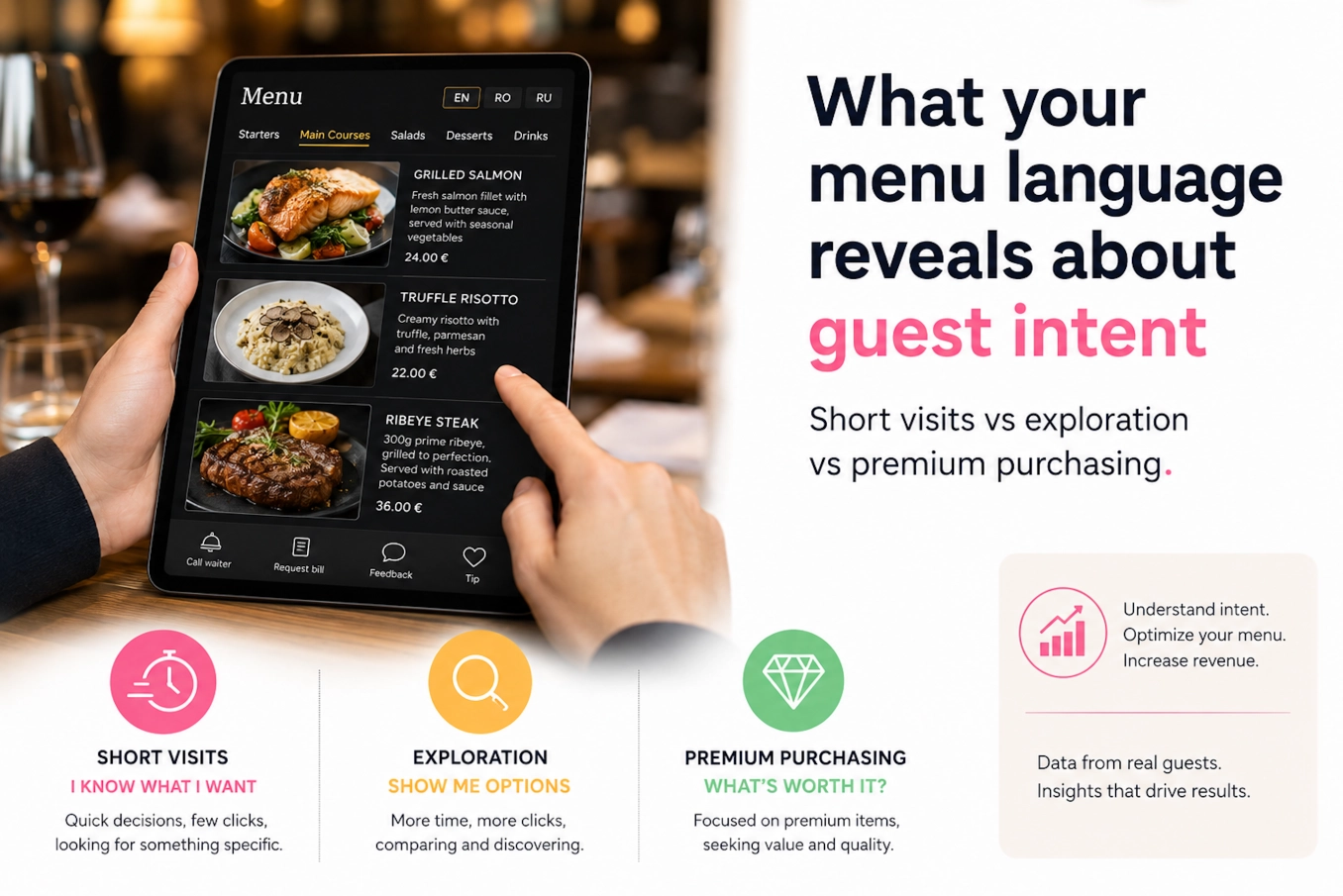
The Pain: You See the Order, But Not the Journey
In a traditional setup, you only see the outcome:
Burger ordered
One beer
No dessert
Looks simple.
But behind that order, there was a process:
They checked the steak
Compared two pastas
Looked at desserts
Considered wine
Hesitated… and dropped it
You don’t see any of that.
And that’s the problem.
What Those 2 Minutes Actually Look Like
With Oto digital menu, those 2 minutes are no longer a black box.
You can break them down step by step:
First 10–15 seconds: Orientation
Guest opens the menu
Scrolls quickly
Looks for categories
This is where first impressions are formed.
If your menu is confusing here, you’ve already lost them.
30–60 seconds: Exploration
They open multiple dishes
Compare options
Check prices
This is where they typically reach those 12–15 viewed items.
They’re not choosing yet.
They’re filtering.
60–120 seconds: Decision
They revisit 1–2 dishes
Spend more time on specific items
Make the final choice
This is where hesitation happens.
And hesitation is where money leaks.
The Hidden Signals Inside Those 2 Minutes
Oto turns these moments into data
You can see:
Time spent per dish
Total session duration
Scroll depth
Repeated views
What dishes are opened together
This creates a map of decision-making.
Not guesses. Actual behavior.
What You Can Learn (And Most Restaurants Miss)
1. Where Customers Get Stuck
If a dish has:
High time spent
Multiple views
Low conversion
That’s hesitation.
Example:
Guests spend 25 seconds on a steak… but don’t order it.
That’s not lack of interest.
That’s doubt.
2. When Customers Decide Faster (And Why)
Some menus show something interesting:
Guests decide in under 60 seconds
Fewer dishes viewed
Higher conversion
Why?
Because the menu is:
Clear
Well-structured
Easy to scan
Less thinking = faster decisions = more orders.
3. When You’re Losing Attention
Another pattern:
Guests scroll deep
Spend 2 minutes
Don’t order
This is a red flag.
It means:
Too many options
No clear guidance
Decision fatigue
You didn’t help them choose.
So they didn’t.
The Oto Solution: Turning Time Into Revenue
Oto acts as a behavioral layer between your guest and your menu
It doesn’t just tell you how long people spend.
It tells you why that time matters.
And more importantly:
What to do about it.
How to Optimize Those 2 Minutes (Practical Moves)
Make the First 15 Seconds Count
Clear categories
Clean layout
No clutter
If they struggle early, they disengage fast.
Reduce the Number of Choices
Keep categories tight
Highlight bestsellers
Remove weak items
Remember: they only look at 12–15 dishes anyway.
Guide the Decision
Add “recommended” tags
Suggest combinations
Place high-margin items strategically
Don’t just show.
Lead.
Fix High-Hesitation Dishes
If people spend time but don’t order:
Improve the photo
Rewrite the description
Adjust positioning
That’s low-hanging revenue.
Use Visuals to Speed Up Decisions
Good photos reduce thinking time.
Less thinking = faster ordering.
The Bigger Insight: Time = Opportunity
Those 2 minutes are not just browsing.
They are:
Evaluation
Comparison
Emotional decision-making
And every extra second of confusion reduces your chances of upselling.
What Happens When You Optimize This
Restaurants using behavioral insights typically see:
Faster decisions
Higher conversion rates
Better average checks
More add-ons (drinks, desserts)
Because the menu starts working with the customer, not against them.
The Bottom Line
Your guests don’t need more time.
They need better guidance during the time they already spend.
You already have their attention for 2 minutes.
The question is:
Are you using it… or wasting it?
Try Oto
If you don’t know what happens during those 2 minutes, you’re guessing.
Oto shows you the full journey.
And helps you turn it into revenue.
Start here:
https://otoqr.app/en/register
FAQ: Time Spent on QR Menus
How long do customers usually spend on a QR menu?
On average, about 2 minutes, viewing around 12–15 dishes before deciding.
Is more time on the menu a good sign?
Not always. Longer time can indicate hesitation or confusion, not interest.
What is the ideal decision time?
There’s no perfect number, but faster, confident decisions usually lead to higher conversion rates.
How can I reduce decision time?
Simplify the menu, improve structure, add visuals, and guide choices with recommendations.
How does Oto track time and behavior?
Oto measures session duration, dish views, interactions, and patterns to reveal how guests actually make decisions.