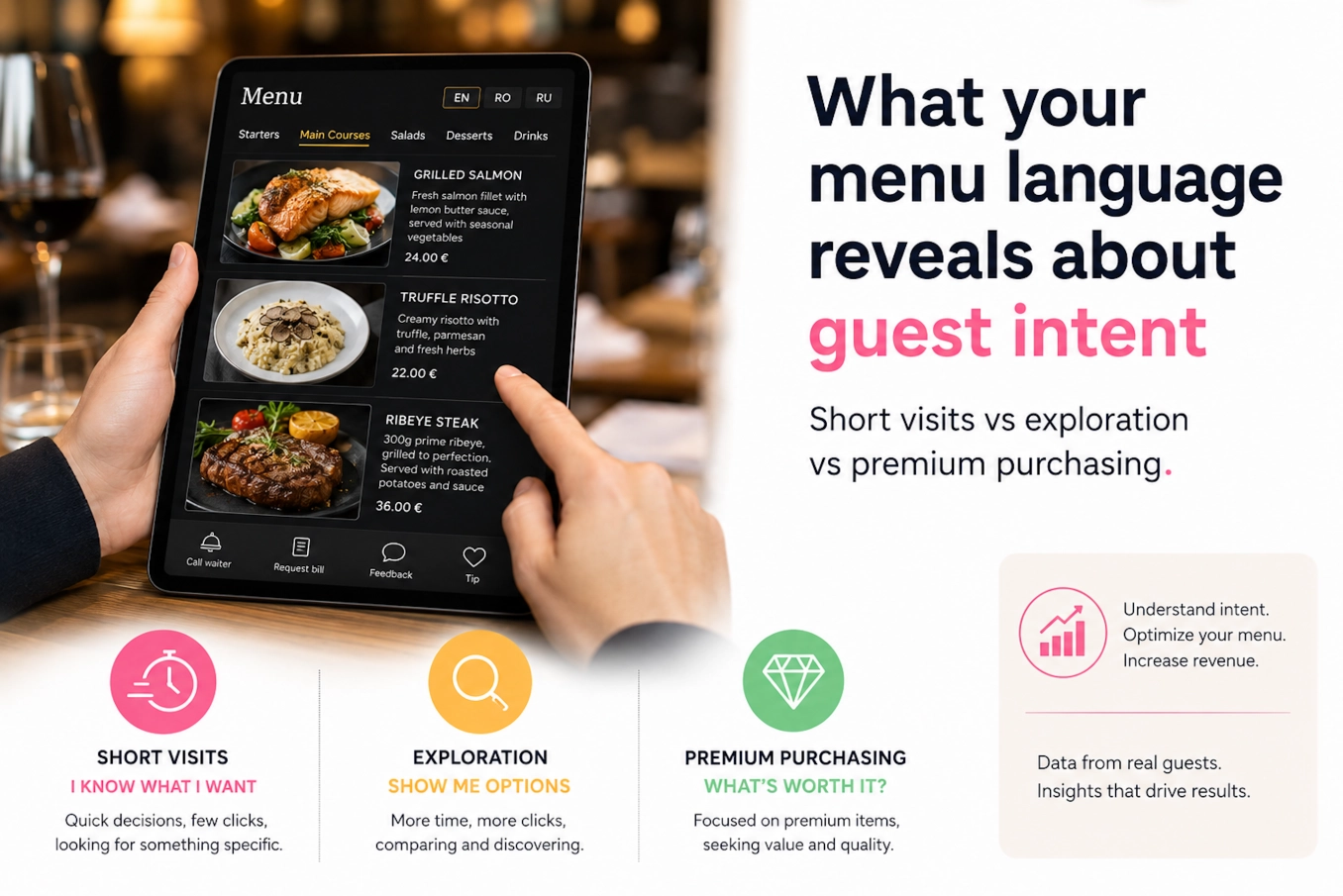
The menu is your most overlooked source of data
Think about how much effort goes into choosing a location, designing the interior, training staff, and promoting the restaurant online.
Now think about the menu.
It is often the single most important sales tool in the business. Every guest interacts with it before ordering. Yet most restaurants know surprisingly little about how customers actually use it.
A paper menu tells you nothing.
Did guests find what they wanted quickly? Did they skip an entire category? Were they interested in a premium dish but discouraged by the price? Did they spend three minutes looking at cocktails before ordering water?
Without data, restaurant owners are left guessing.
A digital QR menu changes that completely.
Attention reveals opportunity
Not every menu item receives the same level of interest.
Some dishes immediately attract attention. Others are ignored. Certain categories become natural starting points for guests, while others are rarely explored.
When restaurants can see which items generate the most views, they gain valuable insights into customer preferences.
For example, a dish may consistently receive high attention but relatively few orders. This could indicate a pricing issue, an unappealing description, poor photography, or a lack of confidence from guests.
Without analytics, that problem remains hidden.
With analytics, it becomes an opportunity for improvement.
Discover where customers hesitate
The buying journey is not always straightforward.
Guests compare options. They evaluate prices. They switch between categories. They return to dishes they previously viewed.
These moments of hesitation are incredibly valuable because they often reveal friction points in the decision-making process.
Perhaps guests spend an unusually long time comparing steaks. Maybe they repeatedly visit the dessert section but rarely order dessert. Maybe they spend significant time viewing signature cocktails but fail to convert interest into purchases.
This information helps restaurant managers identify exactly where customers need more guidance, clearer descriptions, stronger visuals, or better positioning.
Instead of changing the menu based on instinct, they can improve it based on evidence.
Learn what customers actually care about
Restaurant teams frequently debate what should be promoted.
Should the chef's special appear at the top?
Should premium dishes receive more visibility?
Should seasonal items be highlighted?
Analytics provide clear answers.
Rather than relying on opinions, restaurants can see how customers react to different menu structures and promotional strategies.
When guest behavior is measurable, menu optimization becomes an ongoing process rather than a one-time project.
Small adjustments can lead to significant improvements in average order value and overall customer satisfaction.
Identify missed revenue opportunities
Every menu contains hidden revenue opportunities.
Sometimes a profitable dish receives very little visibility because it is buried deep inside a category. Sometimes a high-margin drink attracts attention but lacks the information needed to encourage ordering.
Analytics help restaurants uncover these missed opportunities.
By understanding which products receive attention and which do not, managers can make smarter decisions about placement, descriptions, photos, promotions, and pricing strategies.
The result is often higher sales without increasing advertising budgets or attracting more customers.
The same guests simply make better purchasing decisions.
Understand your international guests
For restaurants serving tourists and international visitors, menu analytics provide another important advantage.
Which languages are used most frequently?
Do visitors from different countries explore different categories?
Are some dishes more popular among foreign guests than local customers?
These insights help restaurants adapt their menus, improve translations, and create experiences that feel more relevant to different audiences.
In competitive hospitality markets, those details matter.
Data-driven restaurants have an advantage
The restaurant industry has become increasingly competitive.
Successful operators no longer rely solely on experience and intuition. They combine experience with data.
They measure what attracts attention.
They understand how guests navigate menus.
They identify friction points.
They optimize continuously.
Most importantly, they make decisions based on what customers actually do, not what they assume customers do.
A QR menu is no longer just a convenient alternative to paper. It is a powerful source of behavioral data that can influence pricing, menu design, marketing campaigns, promotions, and ultimately revenue growth.
The future of restaurant decisions starts with better insights
Every guest interaction with your menu tells a story.
The question is whether you can see it.
Restaurants that capture and understand customer behavior gain a significant advantage. They react faster, optimize smarter, and create experiences that better match guest expectations.
The data is already there. The opportunity is learning how to use it.
Ready to turn menu views into revenue?
With Oto, your menu becomes more than a digital menu. It becomes a behavioral analytics platform that helps you understand what guests view, compare, ignore, and engage with before they place an order.
Stop relying on guesswork and start making decisions backed by real customer behavior.
Register today at Oto and discover how menu analytics can help your restaurant increase sales, improve guest experiences, and unlock new revenue opportunities.
FAQ
What is QR menu analytics?
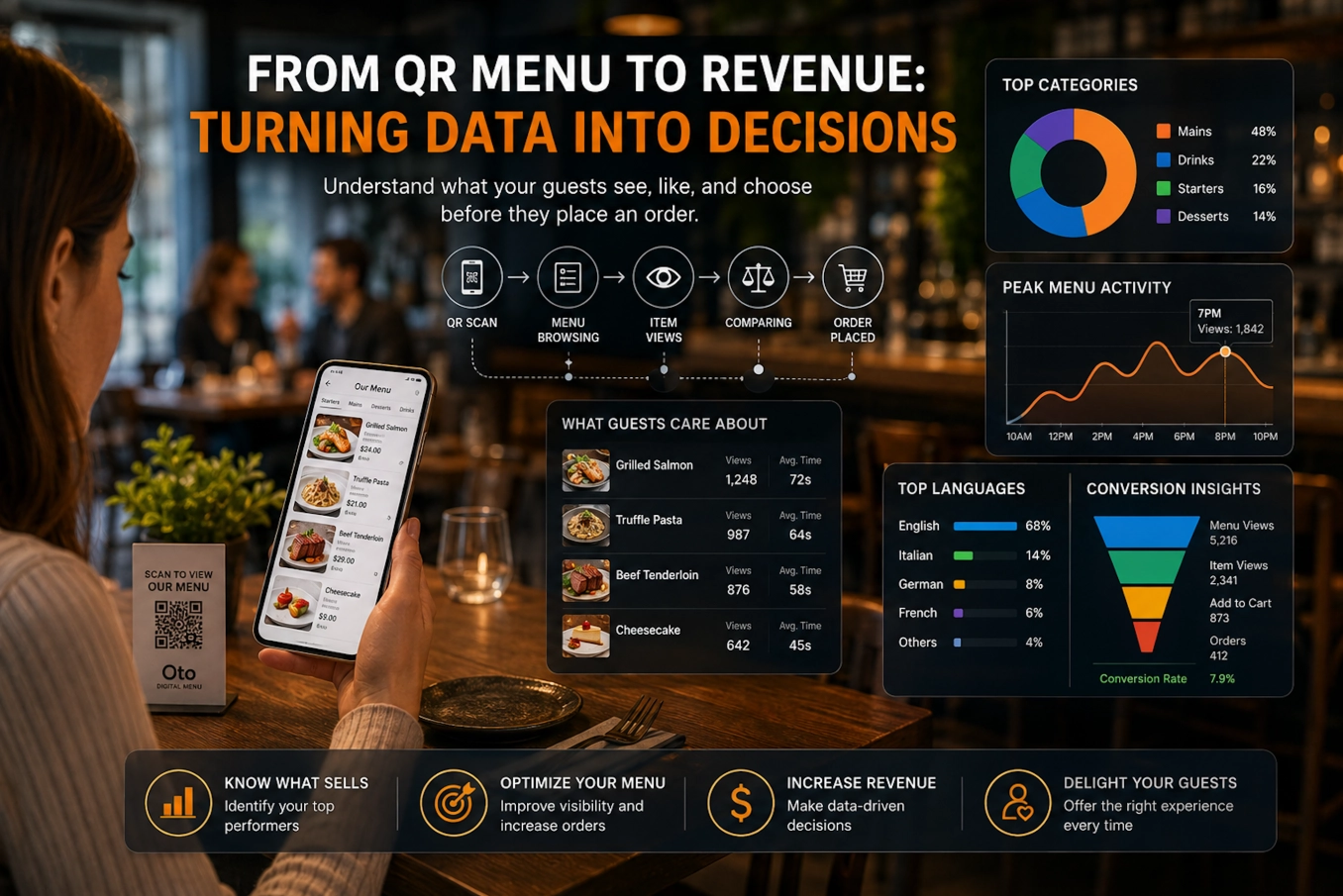
QR menu analytics is the process of tracking how guests interact with a digital restaurant menu. It provides insights such as which dishes receive the most views, how long guests spend on specific items, which categories attract the most attention, and how customers navigate through the menu. These insights help restaurants make better decisions based on real customer behavior.
How can a QR menu increase restaurant revenue?
A QR menu can increase revenue by revealing customer preferences and identifying opportunities for optimization. Restaurants can improve menu layouts, promote high-margin items more effectively, refine descriptions, add appealing photos, and remove friction from the ordering process. Small improvements based on data often lead to higher average order values and increased sales.
What metrics should restaurants track in a digital menu?
Some of the most valuable metrics include:
Most viewed dishes
Most viewed categories
Average time spent on menu items
Customer navigation paths
Language usage
Peak viewing times
Device type
Returning versus new visitors
Menu abandonment rates
Together, these metrics provide a clearer picture of how guests make decisions before ordering.
Can a QR menu show which dishes customers are interested in?
Yes. Digital menu analytics can identify which dishes receive the most attention, how often they are viewed, and how much time guests spend examining them. This helps restaurants understand customer interest even before an order is placed.
Why is customer behavior data important for restaurants?
Customer behavior data removes guesswork from decision-making. Instead of relying solely on assumptions, restaurant owners can see what guests actually do. This allows them to optimize menus, improve promotions, adjust pricing strategies, and create better dining experiences that align with customer preferences.
What is the difference between a QR menu and a paper menu?
A paper menu simply displays information. A QR menu does much more. It can be updated instantly, support multiple languages, display photos, collect customer feedback, enable digital tipping, and provide detailed analytics about guest behavior. In many ways, it functions as both a sales tool and a source of business intelligence.
How do restaurants use menu analytics to optimize their menus?
Restaurants use analytics to identify popular items, discover underperforming dishes, test menu structures, evaluate promotional campaigns, and improve category organization. Data helps managers understand which changes positively influence customer engagement and sales.
Can QR menu analytics help restaurants with international guests?
Absolutely. QR menu analytics can show which languages guests use, where visitors come from, and how different customer groups interact with menu items. These insights help restaurants improve translations, highlight relevant dishes, and create a better experience for tourists and international visitors.
Is QR menu analytics only useful for large restaurant chains?
No. Independent restaurants, cafés, pubs, bars, and restaurant groups can all benefit from menu analytics. Even small improvements in menu performance can have a measurable impact on revenue, customer satisfaction, and operational efficiency.
What is the best QR menu with analytics for restaurants?
The best QR menu platforms combine digital menus with behavioral analytics, menu management, multilingual support, guest engagement tools, and actionable insights. Oto helps restaurants understand how customers interact with menus in real time, transforming menu views into data-driven business decisions.